
INTRODUCTION TO CHAPTER XVII OF IPC
Chapter XVII of the Indian Penal Code, 1860 (Sections 378 to 462), titled “Of Offences Against Property,” which safeguards, preserves, and protects individual rights to property against criminal violations.
The statutory architecture groups ten total property offences into three distinct legal categories: first, eight offences targeting the unlawful deprivation or acquisition of property—comprising Theft (Sections 378–382), Extortion (Sections 383–389), Robbery and Dacoity (Sections 390–402), Criminal Misappropriation (Sections 403–404), Criminal Breach of Trust (Sections 405–409), Receiving Stolen Property (Sections 410–414), Cheating (Sections 415–420), and Fraudulent Deeds and Disposition (Sections 421–424); second, offences involving direct injury to property under Mischief (Sections 425–440); and third, offences violating the possessory right to property through Criminal Trespass (Sections 441–462).
In simple terms, Chapter XVII of the IPC (Sections 378–462) establishes comprehensive penal standards protecting property by dividing offences into three categories: taking or cheating property, physically damaging property through mischief, and unlawfully invading property through criminal trespass.
Offences Against Property
Offences against property under the Penal Code of India, 1860, as those criminal acts wherein an individual is illegally deprived of their valuables or belongings.
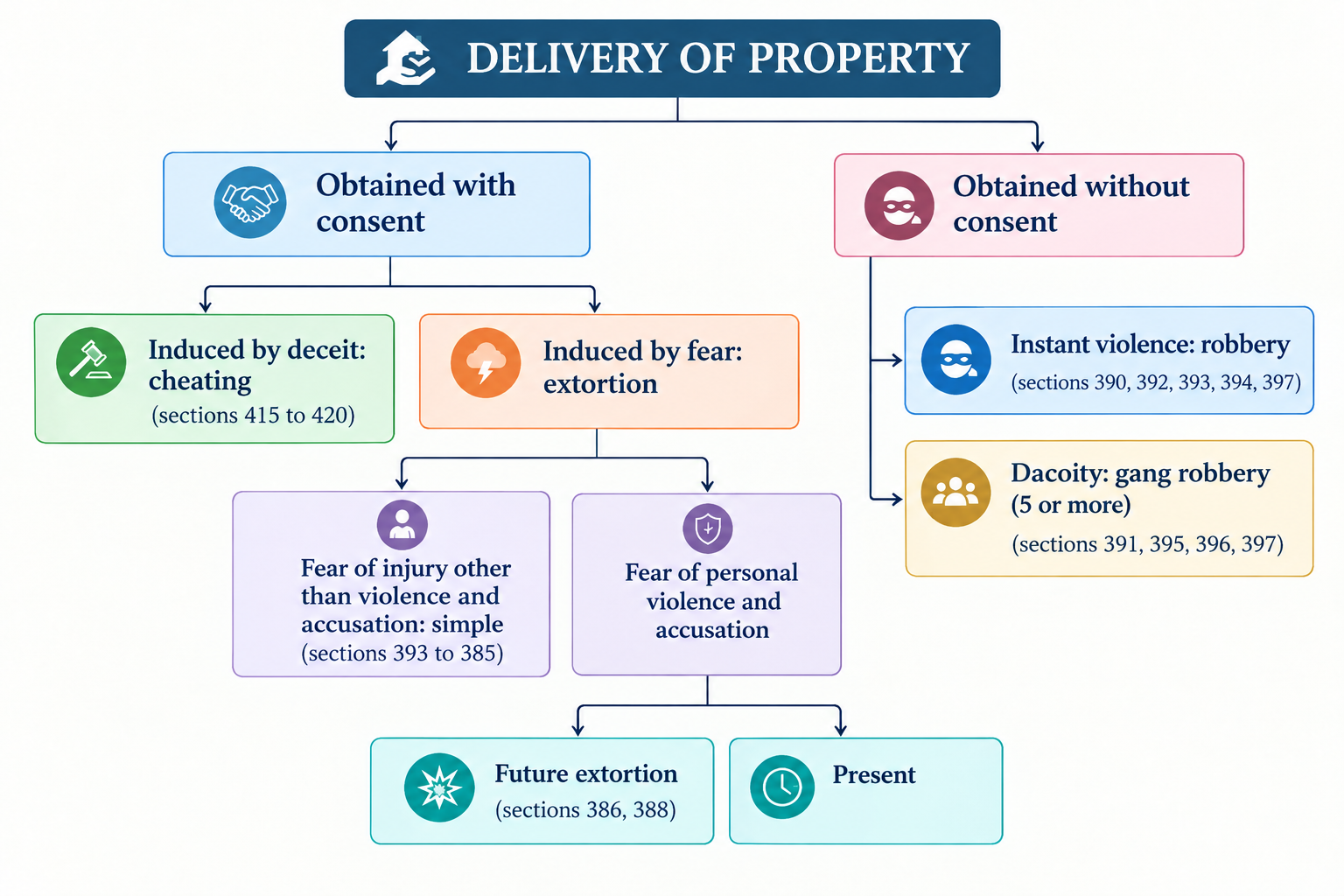
The IPC draws clear statutory distinctions among these property crimes based precisely on the manner in which the deprivation is executed—whether through secret non-consensual taking (theft), coerced delivery under threat (extortion), open violence (robbery and dacoity), fraudulent inducement (cheating), or betrayal of entrusted possession (criminal breach of trust).
In simple terms, Section 14.2 establishes that property crimes involve unlawfully taking away someone’s valuable belongings, with the law defining each specific crime based on the exact method used to take it.
Theft
Section 378 of the Indian Penal Code, 1860, which defines theft as the dishonest moving of any movable property out of another person’s possession without their consent, punishable under Section 379 IPC with imprisonment up to three years, fine, or both.
The statutory framework underscores that theft is fundamentally an offence against possession rather than legal ownership, requiring five cumulative ingredients: dishonest intention, movable property, taking out of possession, physical movement, and lack of express or implied consent.
Five statutory explanations clarify that items attached to earth become movable upon severance (with the act of severance itself constituting movement), while movement can be effected by removing obstacles, untethering animals, or tapping pipelines.
While temple idols, museum paintings, and piped gas/water constitute movable property subject to IPC theft, electricity falls under Section 135 of the Electricity Act, 2003, and human bodies (unless preserved for scientific use) cannot be subjects of theft.
In simple terms, Section 378 IPC makes it a crime to move any portable property out of someone else’s possession with dishonest intent without their permission, treating the slightest movement—including severing a tree or driving a pack animal—as a completed act of theft punishable by up to three years in prison.
Theft under English Law
The framework of theft under Section 1(1) of the English Theft Act, 1968, which defines theft as the dishonest appropriation of property belonging to another with the specific intention of permanently depriving the owner of it, punishable under Section 7 with up to 10 years imprisonment.
Unlike Indian law—which requires five ingredients centered on moving property out of possession and recognizes that even temporary deprivation constitutes theft under Section 378 IPC—English law requires four ingredients centered on appropriation and permanent deprivation.
Regarding spousal property, Section 30 of the English Theft Act 1968 establishes criminal liability between spouses as if they were unmarried, a principle reflected in Indian law across Hindu and Muslim personal legal frameworks.
Because criminal law does not presume a married couple to be a single legal entity, a spouse—such as a husband unlawfully taking his wife’s exclusive stridhan—remains fully liable for theft.
In simple terms, while English law requires an intention to permanently keep stolen property, Indian law punishes even temporary taking, with both legal systems holding husbands and wives criminally liable if they steal each other’s individual property.
KN Mehra v. State of Rajasthan
In KN Mehra v. State of Rajasthan, the Supreme Court of India upheld the Section 379 IPC theft conviction of an Indian Air Force Academy trainee cadet and a discharged co-cadet who took off in an unauthorized Harvard HT 822 aircraft without flight clearance or training protocols, flying it into Pakistan.
The Supreme Court rejected the defense of implied consent, ruling that general trainee status does not grant permission for unauthorized, off-schedule flights on non-designated aircraft, especially after ignoring recall signals.
Interpreting “dishonestly” under Section 24 IPC alongside “wrongful gain” and “wrongful loss” under Section 23 IPC, the Court established that temporary unauthorized usage of an asset provides a wrongful gain of temporary benefit to the offender while inflicting a wrongful loss on the lawful owner by depriving them of possession and control.
In simple terms, KN Mehra v. State of Rajasthan establishes that taking someone’s property without authorization—even temporarily and with no intention of permanently keeping it—constitutes theft under Section 378 IPC because temporary unauthorized use creates both wrongful gain to the taker and wrongful loss to the owner.
State of Haryana v. Hussain
In State of Haryana v. Hussain, the Supreme Court of India, per Abhay Manohar Sapre, J., dismissed a state appeal challenging a High Court judgment that acquitted the respondent of charges under Sections 380, 457, and 460 IPC (theft in a dwelling house, criminal trespass, and nocturnal house-breaking).
The Apex Court reiterated the settled constitutional and procedural principle that when reviewing an order of acquittal, the Supreme Court will not re-appreciate the evidence if the High Court’s view is reasonable, justified, and grounded in cogent reasoning.
Supreme Court interference is strictly limited to instances where the High Court fails to record reasons, ignores material evidence, or reaches a finding that is wholly perverse or contrary to law.
Complementing this evidentiary standard, the text highlights established property jurisprudence: temporarily taking an official file from a government office without authorization—even for just a day or two—constitutes theft under Section 378 IPC, while obtaining property through deception satisfies the criteria for theft under English law.
In simple terms, State of Haryana v. Hussain establishes that the Supreme Court will not overturn a High Court’s acquittal if its reasoning is logical and supported by evidence, while reinforcing that even the short-term, temporary removal of official files without permission constitutes criminal theft.
R v Davie
In R v Davie, the English Court of Appeal affirmed the conviction of a care home manager who tricked elderly residents into signing the back of their cheques under the false impression that they were signing ordinary pieces of paper.
The Court held that because the victims lacked knowledge of what they were signing, legal property in the cheques remained with the residents and did not pass to the accused.
By depositing the cheques into his personal account, the defendant committed obtaining property by deception by falsely representing to the bank that the payees had validly authorized the financial transfers.
Complementing this deception doctrine, criminal jurisprudence establishes that swapping or altering price tags on goods to pay less than the actual price amounts to an unlawful appropriation of property with dishonest intent, satisfying the statutory elements of theft.
Anderton v Wish
In Anderton v Wish, the court allowed the prosecutor’s appeal against an acquittal, establishing that a retail shopper who transposes price labels between items to secure a lower purchase price commits theft under Section 3 of the Theft Act, 1968.
The decision holds that physical interference with a price tag constitutes an immediate, unauthorized assumption of the rights of an owner, meaning the statutory element of appropriation is fully satisfied at the point of label alteration rather than upon exiting the store premises.
Complementing this doctrine on appropriation, established jurisprudence affirms that even when assets or funds are originally transferred as a gift, the dishonest appropriation of those gifted funds can ground full criminal liability for theft.
R v Hinks
In R v Hinks, the House of Lords (by a 3:2 majority) affirmed the theft conviction under Section 1(1) of the Theft Act 1968 of a woman who influenced a 53-year-old vulnerable man into withdrawing approximately $60,000 from his building society accounts and transferring it into her personal account.
Rejecting the appellant’s argument that valid civil gifts transfer indefeasible title and preclude theft, the House of Lords established that criminal “appropriation” can occur even when an owner validly transfers full legal title or consents to the transfer without retaining any proprietary interest.
The Court strictly separated the physical element of appropriation from the mental element of dishonesty, ruling that accepting a gift constitutes theft if the recipient knows the donor is mentally vulnerable such that ordinary, decent people would consider taking the gift dishonest.
Complementing this ruling on financial exploitation, legal precedent holds that in ATM or electronic fund transfers executed through deception, specific identification of the destination account is not required to establish the offense.
Re Holmes
In Re Holmes, the Court of Appeal affirmed extradition proceedings by determining that unauthorized automated bank transfers confirmed through deceptive messages constitute obtaining a money transfer by deception under Section 15A of the UK Theft Act, 1968.
The Court established that a statutory money transfer occurs whenever a debit in one account directly yields a causal credit in another, clarifying that “credited” under Section 15A means placing funds unconditionally at the transferee’s disposal.
The judgment ruled that sending fraudulent messages to lift administrative reservations on transferred funds deceives bank personnel, and the prosecution is not required to identify the exact account debited or its balance state so long as a causal link between the debit and credit exists.
Complementing these financial deception standards, established jurisprudence under Section 49(2)(b) of the UK Criminal Justice Act, 1988, specifies that money laundering convictions require affirmative proof that the laundered property represents direct proceeds of drug trafficking.
R v Montila
In R v Montila, the court allowed the defendants’ appeals and quashed their convictions under Section 49(2) of the Drug Trafficking Act 1994 and Section 93C(2) of the Criminal Justice Act 1988.
The court established that to secure a conviction for money laundering, the Crown must affirmatively prove that the property being converted, concealed, or transferred was in actual fact the proceeds of drug trafficking or criminal conduct.
The judgment highlighted that while a defendant may suspect clean property to be illicit, one cannot legally “know” property to be proceeds of crime if it is not so in reality.
Consequently, the underlying illicit origin of the property constitutes an essential element of the actus reus of the offense, meaning that without proof of actual criminal proceeds, a charge of money laundering cannot stand.
Extortion
The statutory principles of extortion under Sections 383 to 389 of the Indian Penal Code, 1860, establishing Section 383 as the defining provision and Section 384 as the punishing provision, carrying up to three years of imprisonment, a fine, or both.
Under Section 383 IPC, extortion is committed when an offender intentionally induces fear of injury in a person, dishonestly compelling them to deliver property, valuable securities, or signed documents convertible into financial obligations.
Section 385 IPC further criminalizes putting or attempting to put anyone in fear of injury to commit extortion, carrying a penalty of up to two years imprisonment or fine.
As affirmed by the Patna High Court in 1941, the statutory prerequisite of extortion demands an actual delivery of property by a victim motivated by fear, distinguishing it from acts involving mere physical force, such as forcibly taking a thumb impression.
Jadunandan Singh v. Emperor
In Jadunandan Singh v. Emperor, the Patna High Court set aside a Section 384 IPC extortion conviction where the accused assaulted the victims and forcibly impressed their thumbs onto blank papers capable of being converted into valuable securities.
The High Court ruled that under Section 383 IPC, extortion requires proving both that the victim was put in fear of injury and was thereby dishonestly induced to deliver the property or signed documents.
Because the prosecution merely established that the thumb impressions were forcibly taken rather than voluntarily surrendered under induced fear, the essential statutory element of delivery was absent, reducing the offense to the use of criminal force punishable under Section 352 IPC.
Complementing this requirement for concrete injury, established precedent affirms that invoking threats of divine displeasure fails to satisfy the statutory threshold of putting a person in fear of injury required for extortion.
Tanumal Udha Singh v. Emperor
In Tanumal Udha Singh v. Emperor, the court established that issuing a general threat of divine displeasure to compel debt repayment fails to satisfy the statutory criteria for extortion under Sections 383 and 385 or spiritual intimidation under Section 508 of the Indian Penal Code.
The judgment clarifies that for a threat to constitute an “injury” in extortion jurisprudence, it must stem from an “illegal” act—which, pursuant to Section 43 IPC, is strictly defined as an act that constitutes a criminal offence, is prohibited by law, or provides grounds for a civil action.
Because invoking divine or spiritual consequences is neither a crime nor a civil tort, it does not constitute a legal injury capable of breaking free will to induce property delivery.
Complementing this framework on the scope of property, comparative authority under the US Hobbs Act (18 USCA Section 1951(b)(2)) reaffirms that coercing an individual to issue a favorable investment recommendation does not constitute the actual obtaining of property from another.
Sekhar v. United States
In Sekhar v. United States, the United States Supreme Court, in an opinion delivered by Justice Scalia, reversed the Second Circuit Court of Appeals and set aside the Hobbs Act (18 USC § 1951) conviction of venture capital partner Giridhar Sekhar.
Sekhar had sent extortionate, anonymous e-mails threatening to expose the New York State Comptroller’s General Counsel’s alleged extra-marital affair unless the General Counsel recommended approving a state pension fund investment.
The Supreme Court held that coercing an individual to issue a specific investment recommendation does not constitute “the obtaining of property from another” under Section 1951(b)(2).
Reasoning that extortion strictly requires obtaining transferable property capable of being passed from victim to offender, the Court concluded that an unexecuted professional recommendation or advisory opinion cannot constitute property for extortion purposes, rejecting the Second Circuit’s view that free exercise of professional judgment represents an extortable proprietary right.
Robbery and Dacoity (Gang Robbery)
Section 390 of the Indian Penal Code, 1860, which establishes that robbery is an aggravated form of either theft or extortion accompanied by immediate violence or the threat of violence.
Theft becomes robbery when the offender voluntarily causes or threatens instant death, hurt, or wrongful restraint in order to commit theft, during its commission, or while carrying away stolen property.
Extortion becomes robbery when committed in the victim’s presence by instilling fear of instant harm, compelling immediate delivery of property on the spot.
Under Section 392 IPC, robbery is punishable by rigorous imprisonment up to ten years and a fine, with an enhanced penalty of up to fourteen years if committed on a highway between sunset and sunrise.
In simple terms, Section 390 IPC elevates theft or extortion to robbery whenever immediate physical force, restraint, or threat of instant harm is used to take property, carrying severe penalties under Section 392 IPC that increase up to fourteen years for nighttime highway robberies.
Mohd. Anwar v. State (NCT of Delhi)
In Mohd. Anwar v. State (NCT of Delhi), the Supreme Court, per Surya Kant, J., dismissed the appeal of an accused convicted under Section 394 IPC and Section 25 of the Arms Act for an armed midnight robbery where Rs. 30,000 was extorted at knife and gunpoint.
The Supreme Court reaffirmed the evidentiary standard for the defense of mental unsoundness under Section 84 IPC, holding that the accused must prove by a preponderance of probabilities that a severe mental disease impaired their capacity to distinguish right from wrong specifically at the time of the commission of the offence.
Finding no merit in the insanity defense and upholding the High Court’s modified conviction from Section 397 IPC (which prescribes a mandatory minimum sentence of seven years for robbery involving deadly weapons or attempted grievous hurt) to Section 394 IPC based on credible witness testimonies, the Court affirmed the two-year sentence.
Ram Ratan v. State of Madhya Pradesh
In Ram Ratan v. State of Madhya Pradesh, the Supreme Court, per A.S. Bopanna, J., modified the conviction of an accused who participated in a midnight robbery where a co-accused pointed a gun at the victim’s chest to steal a motorcycle and mobile phone.
The Apex Court upheld the substantive conviction for robbery under Section 392 IPC but set aside the enhanced conviction under Section 397 IPC, affirming that Section 397 applies strictly to the individual offender who actively uses or brandishes the deadly weapon rather than non-wielding accomplices.
This individual application under Section 397 IPC stands in contrast to the constructive joint liability framework prescribed under Section 394 IPC (where causing hurt renders all joint perpetrators liable to life imprisonment) and Section 396 IPC (where a murder committed by any single individual during a dacoity imputes equal criminal liability—including the death penalty or life imprisonment—to every member of the five-or-more-person group).
Shyam Behari v. State of UP
In Shyam Behari v. State of UP, the Supreme Court dismissed the appeal of an accused convicted under Section 396 IPC for dacoity with murder, rejecting the defense argument that a killing committed while fleeing without booty does not qualify as murder committed in the commission of dacoity.
The Court affirmed that Section 396 IPC is fully attracted even during an uncompleted attempt to commit dacoity or when a murder is perpetrated while the offenders are securing a safe retreat, holding that the transactional scope of dacoity extends to the escape phase regardless of whether stolen property was successfully acquired.
Hari Om @ Hero v. State of U.P.
In Hari Om @ Hero v. State of U.P., the Supreme Court, per Uday Umesh Lalit, J., evaluated the brutal Deepawali night dacoity and quadruple murder of Smt. Nirdosh Devi and her three children aged 18, 12, and 10 in Firozabad, where the victim was throat-slit and her children throttled to death before looted ornaments and cash were recovered.
The trial court had sentenced Hari Om to death and co-accused to life imprisonment under Section 396 IPC, a decision partially modified by the High Court by acquitting three co-accused while affirming convictions for Hari Om, Sanjay, and Saurabh based on recovered stolen assets, matching latent fingerprints, and the direct testimony of the 5-year-old child survivor PW5 Ujjwal.
However, the Apex Court allowed the appeals of the remaining convicts, setting aside their convictions and sentences under Section 396 IPC and Section 412 IPC and acquitting them of all charges.
This ruling illustrates that even in cases involving extreme brutality and child eyewitness testimony corroborated by latent fingerprint lifts, failure to satisfy the strict standard of proof beyond reasonable doubt across all evidentiary links mandates complete acquittal.
Criminal Misappropriation
The legal framework governing criminal misappropriation under Sections 403 and 404 of the Indian Penal Code, 1860, distinguishing it from theft by focusing on dishonest conversion following innocent or non-trespassory possession.
Section 403 IPC penalizes whoever dishonestly misappropriates or converts any movable property to their own use with up to two years’ imprisonment, a fine, or both, establishing under Explanation 1 that even temporary misappropriation completes the offense.
Explanation 2 clarifies that finders of lost property are protected when acting to protect or return items, but commit misappropriation if they convert property before using reasonable means and waiting a reasonable time to find the owner.
To afford heightened statutory protection to vulnerable estates prior to legal administration, Section 404 IPC penalizes the dishonest misappropriation of property held by a deceased person at death with up to three years’ imprisonment, elevating the maximum sentence to seven years if committed by a clerk or servant of the deceased.
Ramaswamy Nadar v. State of Madras
In Ramaswamy Nadar v. State of Madras, the Supreme Court, per Sinha, J., set aside a Section 403 IPC conviction against a prize-competition proprietor who collected Rs 1,15,000 in entry fees but failed to disburse promised prizes totaling Rs 3,10,000 from the net proceeds of Rs 96,000.
The Apex Court held that to establish an offense under Section 403 IPC, the prosecution must prove that the property belonged to the complainants, that the accused converted that specific property to his own use, and that he acted with dishonest intent.
Reversing the High Court’s judgment, the Supreme Court determined that entry fees paid by participants pass unconditionally into the general revenues of the proprietor, creating a general business obligation to pay prizes rather than a specific legal entrustment over the collected fees.
In the absence of a statutory or contractual directive requiring the proprietor to earmark or apply the collected entry fees exclusively toward prize payouts, the failure to disburse prizes does not constitute dishonest misappropriation of the participants’ property under Section 403 IPC.