
OFFENCES AFFECTING LIFE
Homicide, derived from the Latin “homo” (man) and “caedere” (to kill), describes the killing of a human being by another human being.
Legally, homicide is classified as either lawful (excusable due to self-defense, accident, or lack of criminal intent) or unlawful, which carries criminal liability under the Indian Penal Code.
Unlawful homicides are categorized based on the degree of intent, knowledge, and recklessness involved: murder (Sections 300/302) applies when there is a high certainty of causing death, such as stabbing someone directly in the heart; culpable homicide (Sections 299/304) applies when the act carries a lower probability of death, such as causing a fatal skull fracture with a stick; and causing death by negligence (Section 304A) addresses reckless acts without lethal intent, such as causing a fatal car crash after falling asleep at the wheel.
In cases where an individual inflicts only mild force intended as minor discipline—such as hitting a servant with a small stick—and unintentionally causes death due to an unknown pre-existing medical condition like an enlarged spleen, the law holds the perpetrator liable only for simple hurt under Section 319 rather than culpable homicide or murder.
8.1.1 Causal Connection between the Act and the Death
Under Section 8.1.1, titled “Causal Connection between the Act and the Death,” criminal liability requires a direct, distinct, and non-remote relationship between the accused’s action and the resulting death.
While the death does not need to occur immediately following the act, criminal responsibility is negated if the causal link is obscure or hidden, if concurrent factors prevent the act from being identified as a substantial cause, or if the chain of causation is broken by subsequent intervening causes.
Ultimately, determining whether a sufficient causal connection exists remains a question of degree that courts must evaluate based on the unique circumstances of each case.
8.1.1.1 Connection between the Act and the Death is Obscure
Under Section 8.1.1.1, titled “Connection between the Act and the Death is Obscure,” legal principles dictate that criminal responsibility for homicide cannot be established if the connection between the defendant’s act and the victim’s death is too remote, indirect, or unexpected.
For example, if a person commits suicide due to emotional distress caused by a family member’s behavior, the law considers the causal link far too obscure to ground a homicide charge.
Similarly, minor actions—such as startling a sleeping person, moving a pillow, or breaking bad news—might trigger a fatal reaction in someone with severe heart disease.
Although a physical chain of cause and effect exists, the law withholds criminal liability for acts that do not ordinarily produce death because the outcome is remote and improbable.
The sole exception occurs when the perpetrator specifically intends to cause death, knowing the victim’s heightened vulnerability, under Section 300(2) of the IPC.
8.1.1.2 Difficulty in Ascertaining Immediate Cause of Death Due to Inconspicuous Concurrent Cause of Death
How the law attributes legal responsibility when secondary or concurrent factors complicate the immediate cause of death following an initial injury.
The legal framework establishes that an assailant remains responsible for a victim’s death if the victim dies following standard surgical care, refuses necessary medical intervention, or fails to follow medical instructions.
Although secondary factors may act as the immediate cause of death, the original injury remains the direct underlying cause without which death would not have occurred.
The key exception occurs when medical personnel act with incompetence, ignorance, or bad faith; in such instances, the improper medical treatment breaks the chain of causation, relieving the original inflictor of liability for the death.
8.1.1.3 Intervention of Subsequent Causes
“Intervention of Subsequent Causes,” the law examines how intervening factors can break the legal connection between an act and a resulting death.
An act that indirectly leads to a fatal outcome—such as encouraging someone to enter an area affected by a contagious disease in the hope they contract it—is considered legally remote and contingent on external variables, making it insufficient to support a charge of homicide.
Criminal responsibility requires either direct causation or the presence of criminal intent, knowledge, or recklessness; where these elements or a clear causal chain are absent, the outcome is not penalized as homicide.
To cover non-fatal or indirect acts, the Indian Penal Code of 1860 includes specific provisions punishing abetment of suicide (Sections 305 and 306), attempt to murder (Section 307), attempt to commit culpable homicide (Section 308), and attempt to commit suicide (Section 309).
Furthermore, established jurisprudence maintains that if a victim refuses medical care following an attack, that refusal does not sever the chain of causation, leaving the attacker liable for the resulting death.
R v Blaue
In R v Blaue (1975), the Court of Appeal considered whether a victim’s religious refusal of life-saving medical care breaks the legal chain of causation.
The defendant stabbed a woman, puncturing her lung. As a Jehovah’s Witness, she refused a required blood transfusion on religious grounds and subsequently died from internal bleeding.
Blaue appealed his manslaughter conviction, arguing that her refusal broke the causal link.
Lord Justice Lawton dismissed the appeal, invoking the precedent from R v Smith that an original wound remains the legal cause of death so long as it is an active and substantial factor.
The court affirmed the principle that assailants must take their victims as they find them, holding that a victim’s religious decision to decline treatment does not relieve the attacker of criminal liability when the fatal injury was inflicted by their violent act.
R v Malcherek; R v Steel
In R v Malcherek; R v Steel, the court examined whether withdrawing life support from a severely injured victim breaks the legal chain of causation in a murder charge.
In both cases, victims of violent assaults were placed on life-support machines until attending physicians diagnosed brain death, at which point medical treatment was discontinued and life-support systems were turned off.
The trial judges removed the issue of legal causation from jury consideration, and upon appeal, the appellate court affirmed the convictions and dismissed both appeals.
The court ruled that disconnecting life-support systems does not break the chain of causation between the initial assault and the victim’s death, as the original injury inflicted by the attacker remains the continuing, operating cause of death.
Consequently, medical decisions to cease treatment after brain death do not relieve the accused of full criminal liability.
8.1.2 Offences Affecting the Human Body
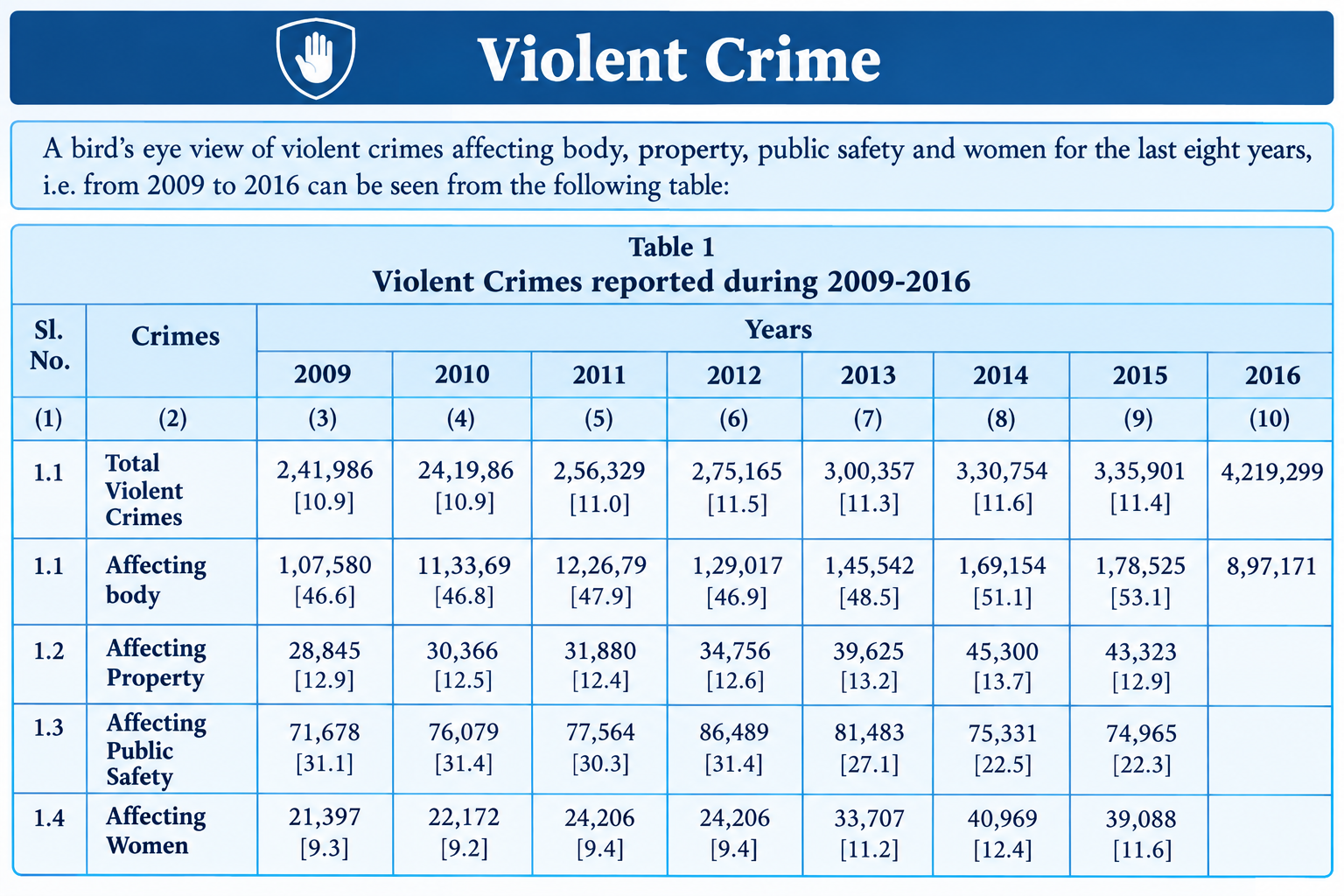
“Offences Affecting the Human Body,” Crime in India statistical data from 2016 indicates that 8,97,171 cases were reported in this category, constituting 30.1% of all IPC crimes registered nationwide.
The majority of these offenses stemmed from road traffic and reckless conduct, with rash driving causing simple and grievous injuries leading the breakdown at 3,48,914 cases (38.9%), followed by causing death by negligence at 1,40,215 cases (15.6%) and grievous hurt at 89,039 cases (9.9%).
Geographically, the highest volume of offenses affecting the human body was concentrated in Uttar Pradesh, which reported 11.2% of the national total, followed by Madhya Pradesh at 9.2% and Maharashtra at 8.9%.
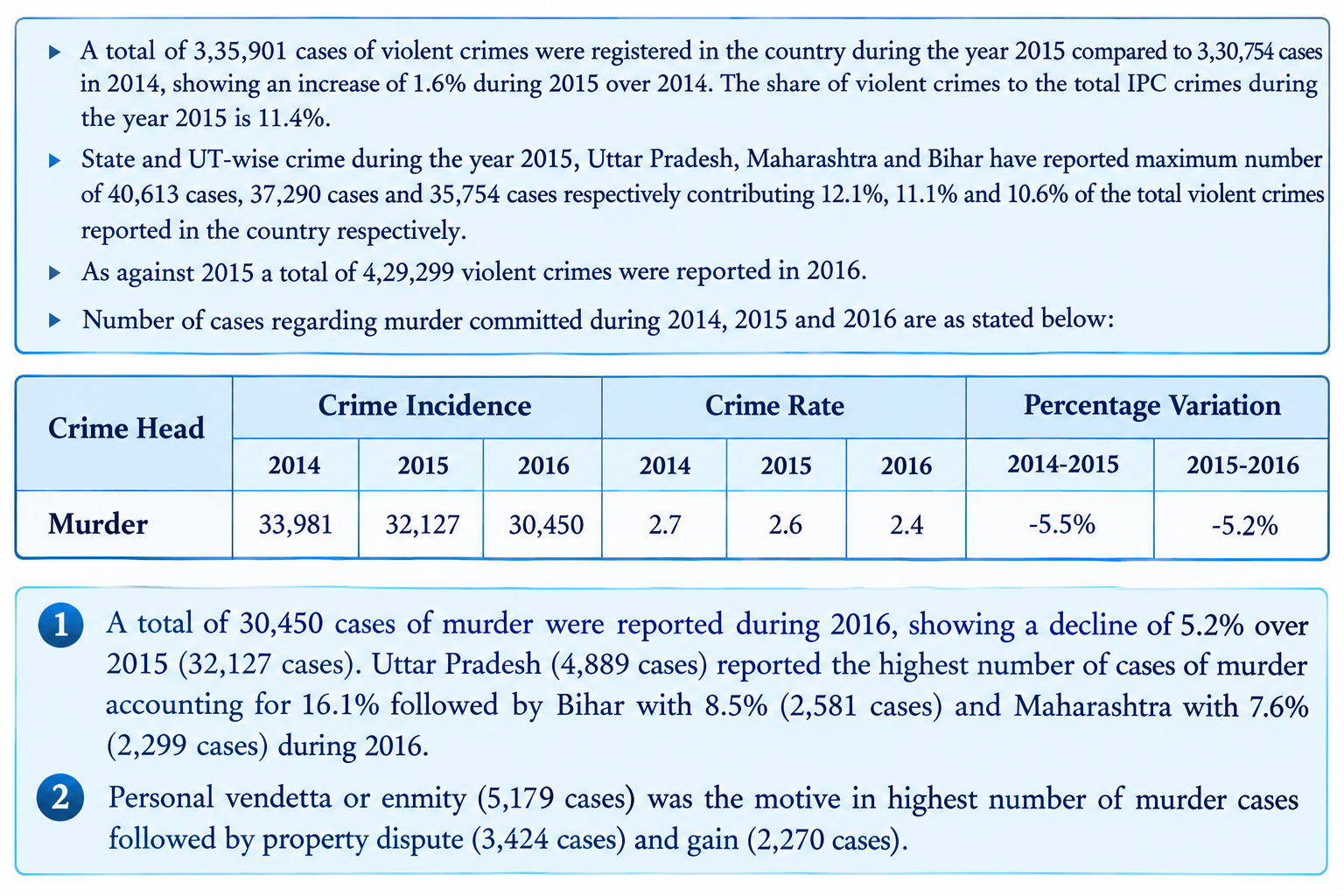
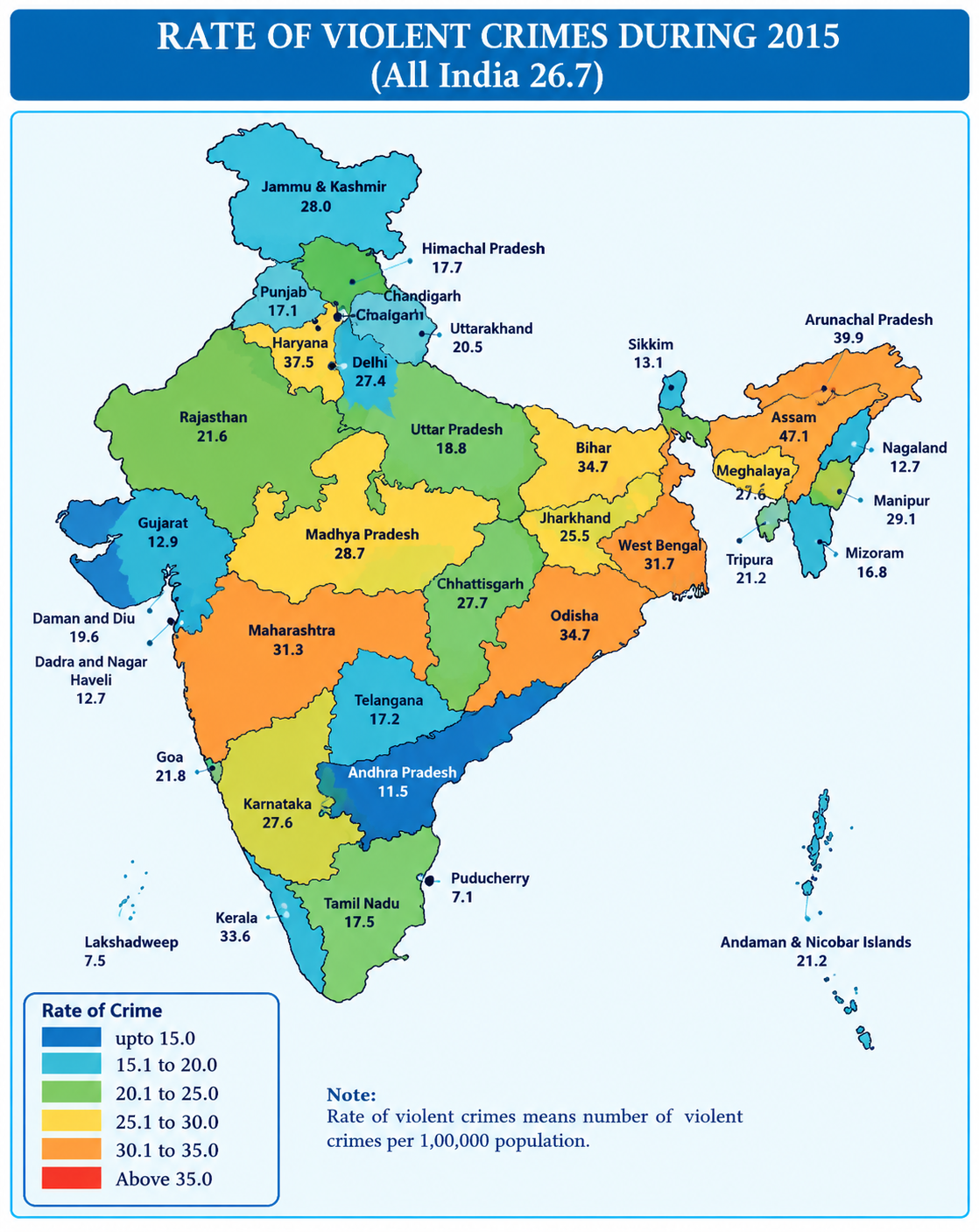
8.1.3 Incidences of Violent Crimes during 2015 (3,35,901 Rate 26.7)
8.2 CULPABLE HOMICIDE
Sections 299 and 304 of the Indian Penal Code define and penalize culpable homicide, establishing that causing death becomes a criminal offense when accompanied by an intention to kill, an intention to inflict injury likely to cause death, or the knowledge that the act will likely result in death.
Illustrative scenarios clarify that setting dangerous traps or tricking an innocent third party into firing a fatal shot amounts to culpable homicide, whereas an accidental killing during an unrelated illegal act (such as shooting at stolen game) lacks the requisite intent or knowledge to qualify.
Explanations under Section 299 further specify that accelerating the death of an ill person or causing fatal injuries where medical treatment was available still constitutes causing death, and that killing a child once any part of it has emerged from the womb can be culpable homicide.
Section 304 assigns statutory penalties based on the actor’s mental state, prescribing life imprisonment or up to ten years plus a fine for intentional killings, while capping imprisonment at ten years, a fine, or both for fatal acts committed with knowledge but without specific intent.
8.3 MURDER
Under Section 300 of the Indian Penal Code, culpable homicide is classified as murder when an act causing death involves high degrees of intention or extreme recklessness.
The statute sets out four specific conditions: direct intent to cause death; intent to cause bodily injury combined with special knowledge that the victim’s pre-existing medical condition makes the injury fatal; intentional infliction of a physical injury that is objectively sufficient in the ordinary course of nature to kill; or committing an imminently dangerous act with the knowledge that it will in all probability cause death, without any legal justification.
These principles are illustrated by cases such as shooting a person to kill them, striking a diseased person knowing the blow will prove fatal, inflicting a naturally lethal sword cut, or firing a loaded cannon into an unsuspecting crowd.
In each scenario, the offender is guilty of murder because the act demonstrates direct lethal intent, deliberate exploitation of a known vulnerability, objective physical lethality, or wanton disregard for human life.
Reg v Govinda
In the landmark case Reg v Govinda, an 18-year-old husband physically assaulted his 15-year-old wife by knocking her to the ground, placing his knee on her chest, and striking her face violently.
Although no skull fracture occurred, the facial blows caused internal bleeding in the brain (extravasation of blood), resulting in her death.
The Sessions Judge initially convicted the accused of murder and passed a death sentence, but when the case was sent to the High Court for confirmation, a judicial split arose regarding whether the act legally constituted murder or culpable homicide.
To resolve the deadlock, the matter was referred to Justice Melvill, who systematically framed a comparative analysis between Sections 299 and 300 of the Indian Penal Code, establishing a clear statutory boundary between culpable homicide and murder based on the degree of intent and probability of death.
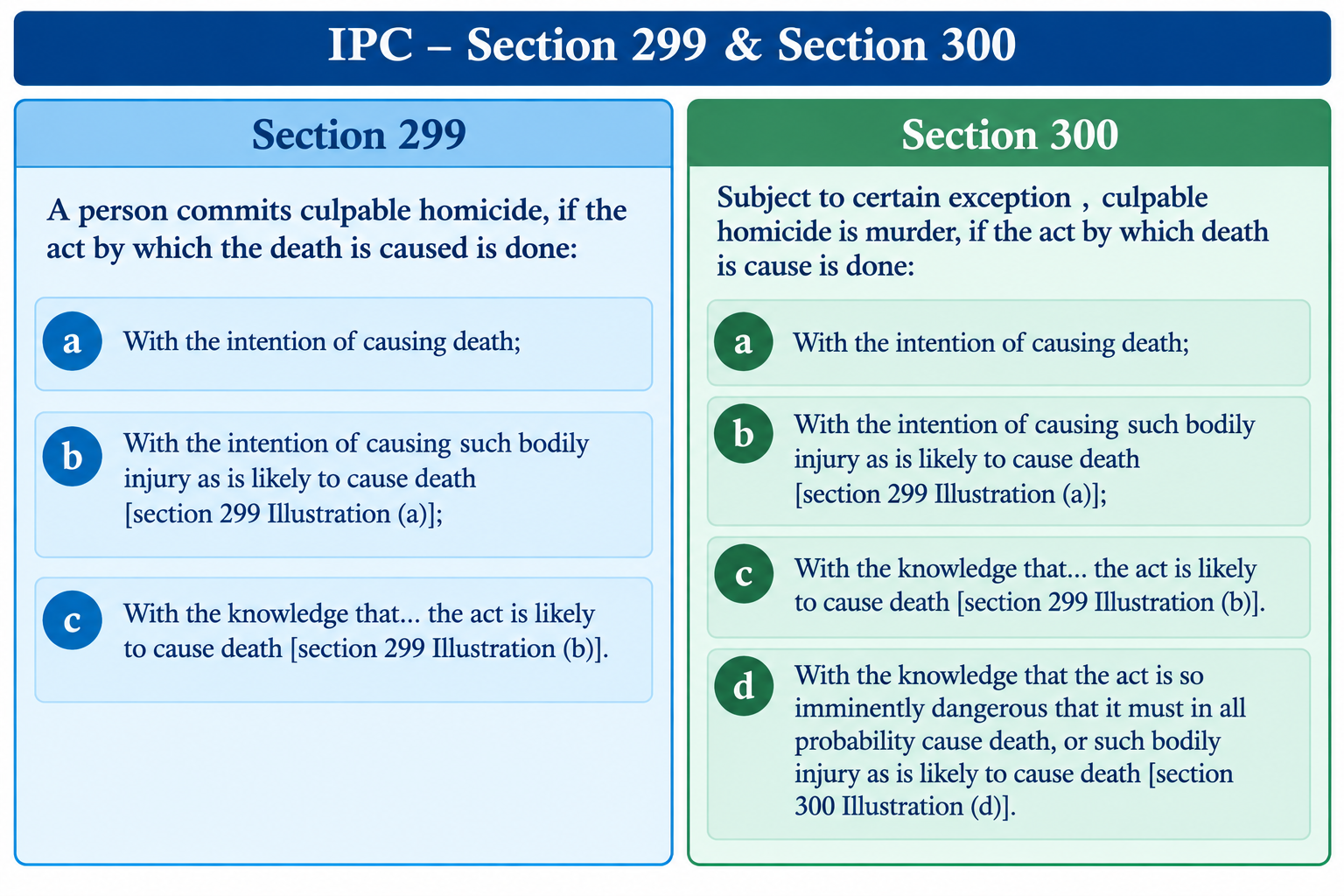
Justice Melvill outlined the pivotal legal test distinguishing culpable homicide from murder, stating that the outcome depends entirely on the degree of risk to human life: if death is merely a likely result, the crime is culpable homicide, but if death is the most probable result or if the injury is sufficient in the ordinary course of nature to cause death, it constitutes murder.
In evaluating the severity of the act, courts examine the nature of the weapon used, noting that while a sword strike to a vital area inherently possesses sufficient lethality to constitute murder, a blow from a fist or stick typically only creates a likelihood of death.
Applying this logic to the case, delivering a violent blow to the eye while the victim is pinned to the ground created a clear risk of fatal brain hemorrhage, rendering death “likely”.
However, because bare fists do not ordinarily cause death in normal circumstances and there was no proven intent to kill, the offense fell short of murder under Section 300 “thirdly”.
Consequently, the accused was convicted of culpable homicide not amounting to murder under Section 304 (Part II) of the IPC and sentenced to seven years of imprisonment.
Madanayya v State of Maharashtra
In Madanayya v State of Maharashtra, the Supreme Court evaluated whether an extended physical assault resulting in cumulative fatal injuries constitutes murder or culpable homicide.
The accused beat his live-in wife overnight; however, she survived until the following evening, conversed with her sister about the incident, and ate a heavy meal shortly before her death.
Lower courts convicted the husband of murder under Section 302 IPC, but the Supreme Court noted that none of the individual injuries were inherently sufficient to cause death and that her survival through the next day disproved a specific intent to kill.
Consequently, the Apex Court allowed the appeal, altered the conviction from Section 302 to Section 304, Part II for culpable homicide not amounting to murder, and ordered the appellant’s immediate release since his sixteen years of imprisonment already exceeded an appropriate sentence for the modified offense.
Vijay Pandurang Thakre v State of Maharashtra
In Vijay Pandurang Thakre v State of Maharashtra, Justice A.K. Sikri evaluated whether a large-scale political clash resulting in a single fatality amounted to planned murder under Section 302 IPC.
Although 21 individuals were originally convicted of murder and related offenses for an attack following a Gram Panchayat election, the Supreme Court observed that the deceased suffered only a single head injury during the scuffle and no other victim sustained lethal injuries on vital organs.
Reassessing the absence of deadly weapons or evidence of a preconceived plan to kill, the Apex Court set aside the murder convictions, ruling that the act constituted culpable homicide not amounting to murder under Section 304 Part II.
The court altered their sentences to seven years of rigorous imprisonment, ordering the immediate release of the appellants as they had already completed that period in custody.
Additionally, the ruling highlights a contrasting 2017 precedent where the sale of methyl-laced spurious liquor resulting in 44 deaths was classified as murder under Section 300 “fourthly”, establishing that selling known toxins with awareness of their fatal consequences constitutes imminently dangerous conduct under the law.
State of Haryana v Krishan
In State of Haryana v Krishan, the Supreme Court addressed a major 1980 “hooch tragedy” in Haryana that resulted in 36 deaths and left 44 people permanently blind after they consumed toxic liquor sold from licensed shops.
Following a joint trial of 48 accused individuals, the trial court convicted vendor owners Krishan and Som Nath under Section 302 (murder) and Section 328 (poisoning) of the IPC, though the High Court later overturned their convictions citing procedural lapses.
Reversing the High Court’s acquittal, Justice A.K. Sikri observed that the respondents’ attempt to destroy remaining bottles after the tragedy conclusively proved they had full knowledge that the liquor contained deadly methyl alcohol.
The Supreme Court held that knowingly selling fatal poisons to unsuspecting villagers falls squarely under Section 300 of the IPC, restoring the trial court’s convictions and life sentences.
Additionally, a referenced 2015 Supreme Court precedent affirms that luring a spouse to an isolated location and causing death by strangulation warrants conviction for murder under Section 302 alongside Section 201 for concealing evidence.
Eshwarappa v State of Karnataka
In Eshwarappa v State of Karnataka, Justice T.S. Thakur examined a case where the appellant, after neglecting his wife (Latha) for an extra-marital relationship, strangulated her to death and staged a false suicide scene by tying a rope to a tamarind tree branch over a pile of stones.
Forensic and medical evidence disproved the suicide defense, establishing homicidal asphyxia caused by forced neck constriction.
While affirming the trial court and High Court findings on murder under Section 302 and destruction of evidence under Section 201, the Supreme Court clarified that the conviction under Section 498A IPC for marital cruelty was not maintainable on the record.
Consequently, the Supreme Court dismissed the appeal, upholding the convictions for murder and destroying evidence.
A related principle noted in the judgment confirms that where common intention (Section 34) in strangulation is proved beyond reasonable doubt, co-accused husband and accomplices remain fully liable for murder under Section 302 regardless of whether formal criminal conspiracy (Section 120B) is separately established.
Shantanu Sitaram alias Anil Divekar v State of Maharashtra
In Shantanu Sitaram alias Anil Divekar v State of Maharashtra (heard alongside Deepak alias Ganesh S Patil v State of Maharashtra), Justice Ashok Bhushan considered appeals against a Bombay High Court decision confirming life sentences for three individuals convicted of murder under Section 302 read with Section 34 IPC.
The primary accused, Shantanu, drove his wife Supriya and nine-month-old daughter away under suspicious circumstances, leading to Supriya’s murder.
Key circumstantial evidence included 30 prosecution witnesses and police recoveries made at the instance of co-accused Rafik and Deepak, which yielded cash, weapons, and gold jewelry worn by the deceased during the incident.
Dismissing the appeals, the Supreme Court held that failing to independently prove a prior criminal conspiracy under Section 120B IPC does not undermine a murder conviction when common intention under Section 34 IPC is fully established.
This principle aligns with a referenced 2017 Supreme Court ruling, which established that delivering repeated targeted strikes to a victim’s head using dangerous weapons demonstrates explicit intention to cause death under Section 302 IPC.
Chandrasekar v State with Balasubramanian v State of TN
In Chandrasekar v State (heard along with Balasubramanian v State of TN), Justice Navin Sinha delivered the judgment upholding life imprisonment convictions under Section 302 IPC for an attack stemming from a previous day’s court acquittal.
The appellants launched a coordinated assault using a hammer, a sickle, and an iron rod, inflicting repeated strikes on the head of the deceased (Gnanasekaran) and injuring his brother-in-law.
The Supreme Court held that indiscriminately striking a sensitive, vital body part like the head with deadly weapons conclusively reflects an individual intention to cause death, rendering detailed inquiries into shared common intention unnecessary.
Furthermore, the Court emphasized that clear, prompt ocular evidence from injured eyewitnesses outweighs technical issues regarding police weapon recoveries, ultimately dismissing the appeal and ordering the convicts to surrender immediately to serve their life sentences.
Gurpal Singh v State of Punjab
In Gurpal Singh v State of Punjab, the Supreme Court considered an appeal where the appellant opened fire following an verbal exhortation, injuring multiple individuals and causing the death of Jatinder Singh.
Although the eyewitness testimony from relatives was found coherent and fully corroborated by firearm injuries, Justice Amitava Roy noted that the shooting was driven by an uncontrollable fit of anger that temporarily deprived the appellant of self-control.
Evaluating these circumstances alongside the 12 years of imprisonment already served, the Supreme Court partly allowed the appeal by converting the conviction from Section 302 IPC (murder) to Section 304 Part I IPC (culpable homicide not amounting to murder) while maintaining Section 307 IPC, reducing the sentence to the period already undergone and ordering his release.
This aligns with a parallel 2016 precedent where a conviction was similarly altered from Section 302 to Section 304 Part I IPC because the victim survived for 62 days after hospital discharge, making it unsustainable to conclude that the inflicted wound was inherently sufficient in the ordinary course of nature to cause death.
Sanjay v State of UP
In Sanjay v State of UP, the court reviewed an appeal against a High Court judgment that had originally upheld convictions for murder and attempted murder under Sections 302, 307 read with Section 34, and Section 452 of the Indian Penal Code.
The case involved appellants who indiscriminately fired country-made pistols at two individuals, inflicting a fatal gunshot wound to the head of the deceased (Roop Singh) and injuring another witness.
Evaluating the appellants’ conduct and joint execution of the crime, the court held that their concerted actions fully established a common intention under Section 34 IPC.
However, regarding the nature of the fatal head injury, the court modified the conviction from Section 302 IPC to Section 304 Part I read with Section 34 IPC.
This legal distinction aligns with established Supreme Court jurisprudence from 1958, which clarifies that when an inflicted injury is proven to be sufficient in the ordinary course of nature to cause death, it falls under clause “thirdly” of Section 300 IPC.
Virsa Singh v State of Punjab
In the landmark decision of Virsa Singh v State of Punjab, Justice Vivian Bose affirmed a life imprisonment conviction under Section 302 IPC for a fatal spear thrust to the victim, establishing the definitive legal framework for murder under Section 300 “Thirdly” of the Indian Penal Code.
The Supreme Court dismantled the defense’s argument regarding intent by laying down a four-step test: the prosecution must objectively prove the existence of the bodily injury, establish its physical nature, demonstrate that the accused intentionally inflicted that specific wound rather than by accident, and show that the injury was medically sufficient to cause death in the ordinary course of nature.
Justice Bose emphasized that while the intention to inflict the physical wound is subjective, evaluating whether that wound is fatal is purely objective.
Consequently, when an offender intentionally strikes a victim with a dangerous weapon—as further reflected in related precedents involving joint, brutal assaults on vital organs—the legal presumption remains that the injury was intended, making the act murder under Section 302 IPC.
State of Haryana v Shakuntala
In State of Haryana v Shakuntala, Justice Swatanter Kumar reviewed a State appeal challenging the High Court’s acquittal of three out of nine accused who were originally convicted for a fatal group assault under Sections 148, 302, and 325 read with Sections 34 and 149 of the Indian Penal Code.
The incident involved an unlawful assembly where initial strikes with iron rods escalated into deadly blows to the heads of Manohar Lal and Sushila, causing both victims to succumb to their injuries on the way to the hospital.
In dismissing the State’s appeal, the Supreme Court affirmed the principle that an acquittal order should not be disturbed merely because a different view of the evidence is possible, thereby keeping the acquittals intact while preserving the convictions of the remaining accused who did not appeal.
This decision reinforces established 2012 jurisprudence, which holds that delivering a fatal blow to a victim’s head—even with an improvised weapon like a piece of wood found at the scene—satisfies the legal threshold for murder under Section 302 IPC read with Section 34 IPC when post-mortem results confirm the injury was sufficient in the ordinary course of nature to cause death.
Lokesh Shivakumar v State of Karnataka
In Lokesh Shivakumar v State of Karnataka, Justices Aftab Alam and R. Dave dismissed an appeal challenging a conviction for murder under Section 302 read with Section 34 of the Indian Penal Code, 1860, which carried a sentence of life imprisonment and a fine.
The accused struck the victim, Dharmraj, on the right side of his head with a wooden piece, causing severe external and internal bleeding across his head, face, and nose that ultimately caused his death.
The Supreme Court upheld the conviction based on post-mortem medical evidence, confirming that the physical trauma inflicted on a vital organ was objectively sufficient to cause death in the ordinary course of nature.
This decision builds upon established 1976 jurisprudence affirming that inflicting bodily injury likely to cause death satisfies clause (b) of Section 299 IPC for culpable homicide, reinforcing that lethal physical violence directed at vital areas supports a full conviction for murder.
Jayaraj v State of TN
In Jayaraj v State of TN, Justice R.S. Sarkaria reviewed a State appeal where the High Court had overturned a trial court acquittal, convicting the appellant under Section 302 IPC for causing the death of Pattu Nadar amid political rivalry.
Re-evaluating the four-prong test for murder under Section 300 “thirdly” IPC, the Supreme Court emphasized that the prosecution must objectively prove not only the existence and intentional infliction of a specific injury, but also that the injury was medically sufficient to cause death in the ordinary course of nature.
Because the prosecution failed to prove beyond reasonable doubt that the abdominal injury was objectively sufficient to cause death rather than merely likely to cause death, the Court held that clause (3) of Section 300 IPC did not apply, bringing the offense under clause (b) of Section 299 IPC instead.
Consequently, the Supreme Court partly allowed the appeal, modifying the conviction from murder under Section 302 IPC to culpable homicide not amounting to murder under Section 304 Part I IPC, consistent with 2008 Supreme Court jurisprudence reinforcing that the distinction between these provisions rests strictly on the proven severity of the injury and the specific intent of the accused.
Bavisetti Kameshwara Rao @ Babai v State of AP
In Bavisetti Kameshwara Rao @ Babai v State of AP, Justice V.S. Sirpurkar addressed whether a single injury inflicted using an everyday tool could sustain a murder conviction under Section 302 of the Indian Penal Code, 1860.
The appellant, a motor mechanic, used a screwdriver to stab an unarmed victim in the abdomen with savage force following a verbal argument, causing a 12 cm deep wound that ruptured the liver and spleen and led to fatal hemorrhagic shock.
Although the defense argued that a solitary blow with a mechanic’s tool lacked the requisite intention to murder—contending the offense should be reduced to culpable homicide under Section 304 Part II IPC—the Supreme Court rejected this plea and dismissed the appeal.
The Court held that when an injury is inflicted upon a vital organ with extreme violence causing near-instantaneous death, it objectively satisfies Clause “Thirdly” of Section 300 IPC as an injury sufficient in the ordinary course of nature to cause death, establishing that even a single blow with an improvised weapon can legally constitute murder under Section 302 IPC.
Mohd. Rafiq @ Kallu v State of Madhya Pradesh
In Mohd. Rafiq @ Kallu v State of Madhya Pradesh, Justice S. Ravindra Bhat reviewed an appeal against a High Court decision that upheld a trial court conviction under Section 302 IPC, sentencing the appellant truck driver to life imprisonment.
The incident occurred when the appellant, after crashing through a forestry checkpoint and hitting a motorcycle, refused to stop for Sub Inspector D.K. Tiwari, warned the officer he would be killed if he boarded, and subsequently pushed him off the moving truck, causing him to fall under the rear wheels and suffer fatal injuries.
Re-evaluating the facts and degree of intent, the Supreme Court altered the conviction from murder under Section 302 IPC to culpable homicide not amounting to murder under Section 299, punishable under Section 304 Part I IPC, thereby reducing the sentence from life imprisonment to 10 years of rigorous imprisonment.
This ruling—noted alongside 1992 precedent regarding single fatal blows inflicted in sudden altercations—demonstrates how the court distinguishes acts committed with knowledge of fatal probability during an impulsive attempt to flee from direct, premeditated intent to commit murder.
Patel Rasiklal Becharbhai v State of Gujarat
In Patel Rasiklal Becharbhai v State of Gujarat, the appellant (A-3) and five others were initially tried for multiple offences under Sections 147, 148, 302, 324, 326, and 447 read with Section 149 of the Indian Penal Code, 1860.
Although the trial court acquitted all defendants, the High Court reversed the decision for A-3, convicting him of murder under Section 302 IPC.
Upon appeal, the Supreme Court set aside the Section 302 conviction and modified it to Section 304 Part II IPC.
The Court held that when the facts establish reasonable doubt regarding whether the accused specifically intended to inflict the particular injury that caused death, the offense falls under culpable homicide not amounting to murder.
Because the accused acted with the legal knowledge that the act was likely to cause death, but without the proven specific intent required for murder, Section 304 Part II IPC applied—a standard consistent with 1982 Supreme Court precedent holding that acts like throwing a child to the ground, causing internal brain congestion, constitute culpable homicide rather than murder when specific fatal intent is lacking.
Sarabjeet Singh v State of UP
In Sarabjeet Singh v State of UP, a dispute arising from a land sale transaction escalated into a altercation where one of the men lifted a four-year-old child and threw him to the ground, causing fatal brain congestion.
The Supreme Court ruled that Section 300 Part I of the Indian Penal Code, 1860 did not apply because the prosecution failed to prove a direct intention to cause death, particularly given autopsy evidence indicating brain congestion does not inherently or necessarily result in death.
However, the Court established that an adult dealing harshly with a young infant is legally presumed to know that an underdeveloped body may suffer fatal consequences, thereby satisfying clause (ii) of Section 299 IPC.
Consequently, the Court convicted the accused of culpable homicide not amounting to murder punishable under Section 304 Part II IPC, contrasting this with cases where striking an individual on the head with a heavy piece of wood provides post-mortem evidence of injuries sufficient in the ordinary course of nature to sustain a full conviction for murder under Section 302 IPC.
Lokesh Shivakumar v State of Karnataka
In Lokesh Shivakumar v State of Karnataka, Justices Aftab Alam and Anil R. Dave dismissed an appeal challenging a conviction under Section 302 read with Section 34 of the Indian Penal Code, 1860, upholding a sentence of life imprisonment and a fine.
The case involved an attack where the accused struck the victim, Dharmraj, on the right side of his head using a piece of wood and a heavy brick, causing severe hemorrhage across his head, face, and nose that proved fatal.
Based on post-mortem findings, the Supreme Court held that the blunt force trauma inflicted on a vital area satisfied Section 300 Clause “Thirdly” IPC as an injury sufficient in the ordinary course of nature to cause death.
This decision underscores how post-mortem medical proof, combined with corroborated eyewitness testimony under Section 3 of the Evidence Act, conclusively establishes murder under Section 302 IPC when fatal weapons are used against vital organs.