Om Prakash v State of UP
In Om Prakash v State of UP, the Supreme Court established the strict evidentiary standard required to invoke Section 376(2)(e) of the Indian Penal Code, which prescribes aggravated punishment for raping a woman known to be pregnant, holding that actual statutory knowledge of the condition must be definitively established by the prosecution.
Overturning lower judicial findings that relied on mere probability of awareness, the highest court ruled that statutory phrasing requiring proof of specific awareness cannot be satisfied through assumptions or general possibilities.
In simple terms, courts cannot impose heavier prison penalties for crimes against pregnant victims unless there is clear proof that the accused explicitly knew about the pregnancy, leaving the baseline rape conviction intact under the general penal provisions.
Vasanta Sampat Dupare v State of Maharashtra
In Vasanta Sampat Dupare v State of Maharashtra, the Supreme Court evaluated the judicial balancing test between aggravating and mitigating circumstances when deciding whether post-conviction prison rehabilitation can override the death penalty in brutal sexual offenses, holding that subsequent prison reform efforts cannot automatically override extreme depravity.
Reviewing the death sentence of a convict who lured, raped, and crushed a four-year-old girl to death with heavy stones, the court examined evidence of his good prison behavior, unblemished jail record, and completion of educational programs offered by IGNOU as potential mitigating factors indicating reform, as judicial discretion requires evaluating the cumulative effect of both aggravating and mitigating factors.
Justice U.U. Lalit affirmed that while courts must weigh mitigating evidence without restricting judicial discretion, post-conviction educational achievements and good conduct do not eliminate extreme culpability.
Dismissing the review petitions and upholding the capital sentence, the Supreme Court held that the extreme barbarity of the crime and the total helplessness of the child victim overwhelmingly outweighed any mitigating circumstances.
In simple terms, taking classes or showing good behavior in prison after committing a horrific rape and murder of a toddler is not enough to avoid the death penalty, since the sheer brutality of the act far outweighs subsequent efforts at self-improvement.
Pradeep Kumar v Union Administration, Chandigarh
In Pradeep Kumar v Union Administration, Chandigarh, the Supreme Court clarified the legal standard for establishing common intention and vicarious liability under Section 376(2)(g) of the Indian Penal Code read with Explanation 1 for the offence of gang rape, establishing that proof of a shared pre-arranged plan or concerted action fastens criminal guilt on all members of a group.
Justice P.P. Naolekar held that while individuals who do not physically commit the act can still be held liable, mere presence at the crime scene is legally insufficient to establish joint liability.
Where evidence shows that an accused arrived late at the scene, engaged solely in consuming alcohol, and was attributed no specific acts of connivance or facilitation, the prosecution fails to prove a prior meeting of minds or common intention.
In simple terms, being in the same room or location where a gang rape occurs does not make a person guilty of the crime, unless prosecutors prove that they actively planned, helped, or agreed to assist in the assault.
Priya Patel v State of MP
In Priya Patel v State of MP, the Supreme Court evaluated whether a woman who actively facilitates a sexual assault can be charged as a principal offender for gang rape under Section 376(2)(g) read with Explanation 1 of the Indian Penal Code, holding that the legal deeming provision applies only to group members who share a common intention to commit rape.
Where a wife walked in on her husband raping a victim, slapped the victim upon her plea for help, and locked the door to enable the assault, the apex court ruled that it is conceptually impossible for a woman to be convicted as a direct perpetrator or co-perpetrator of gang rape under Indian law.
In simple terms, a female cannot be charged with gang rape itself under Section 376(2)(g) IPC—even if she locks a victim in a room to assist an attacker—though she remains legally punishable for abetting the crime under Section 109 IPC.
State of HP v Sanjay Kumar
In State of HP v Sanjay Kumar, the Supreme Court evaluated the evidentiary weight of a child survivor’s testimony, minor trial discrepancies, and delays in reporting intrafamilial sexual abuse under Section 376(2)(f) and Section 506 of the Indian Penal Code.
Reversing the High Court’s acquittal of an uncle who raped his nine-year-old niece, the Supreme Court held that minor or trivial inconsistencies regarding ancillary matters—such as details about stomach ache medication—do not impair the credibility of a victim’s consistent narrative regarding the central assault.
Justice A.K. Sikri emphasized that a brief delay in filing an FIR is fully explained and inconsequential when the accused is a close relative, given the intense emotional trauma and fear of societal stigma surrounding family-related sexual violence.
Reaffirming core evidentiary principles, the court ruled that a sexual assault victim stands on a higher pedestal than an ordinary injured witness and is never an accomplice; requiring independent corroboration as a mandatory rule insults the victim and violates established jurisprudence.
In simple terms, courts cannot overturn the conviction of a child rape offender over minor narrative details or brief delays in police reporting, as the credible, uncorroborated testimony of a child survivor against a family relative is fully sufficient to sustain a conviction.
Mukesh v State of NCT of Delhi
In Mukesh v State of NCT of Delhi, the Supreme Court delivered a landmark ruling on capital punishment, scientific evidence, and the legal sanctity of dying declarations under the Indian Evidence Act in cases of extreme sexual violence.
Validating the conviction and death sentences of the 2012 Delhi gang rape perpetrators, the court held that physical recoveries made under Section 27 of the Evidence Act—corroborated by DNA profiling and medical bite-mark analysis—unquestionably established the identity and guilt of the accused.
Justices Dipak Misra and R. Banumathi affirmed that a voluntary and truthful dying declaration recorded from a mentally fit victim is a substantive piece of evidence capable of forming the sole basis of conviction without mandatory corroboration.
Applying the “rarest of rare” doctrine through a balance-sheet approach of aggravating versus mitigating factors, the Supreme Court ruled that where sexual violence involves unimaginable barbarity, internal organ perforation, and acts that shock the collective conscience of society, life imprisonment is inherently inadequate, leaving the death penalty as the only just sentence under the law.
In simple terms, when gang rape and murder are committed with extreme cruelty and proven through rock-solid DNA evidence and reliable dying declarations, the crime falls into the rarest of rare categories, making capital punishment legally mandatory to preserve justice and societal trust.
State of Assam v Ramen Dowarah
In State of Assam v Ramen Dowarah, the Supreme Court evaluated whether setting a sexual assault victim ablaze to prevent disclosure constitutes murder under Section 302 of the Indian Penal Code or culpable homicide under Section 304 Part II IPC.
Reversing a High Court judgment that had improperly dropped rape charges and downgraded murder to culpable homicide under the mistaken assumption of consensual intercourse, the Supreme Court held that the circumstantial and oral evidence completely disproved any defense of consent.
Justice Arun Mishra emphasized that pouring kerosene and burning a victim following a sexual assault—even if prompted by her threat to inform her family—demonstrates a clear, deliberate intention to cause death in order to silence her.
In simple terms, setting a woman on fire after raping her to stop her from telling anyone is a clear act of murder, and lower courts cannot treat such brutal acts as consensual or lesser killings.
Raja v State of Karnataka
In Raja v State of Karnataka, the Supreme Court reaffirmed the foundational mandate that criminal guilt must be established beyond reasonable doubt, evaluating the plausibility of High Court decisions that overturn trial court acquittals.
Justice Amitava Roy held that where the prosecution’s case contains irreconcilable inconsistencies, anomalies, and omissions, appellate courts cannot strain the evidence to favor the prosecution.
The Supreme Court emphasized that the High Court committed a logical error by exonerating the appellants of the abduction charge under Section 366 IPC while simultaneously upholding related charges, as abduction constituted an inseparable component of the alleged chain of events.
Because the prosecution failed to prove its charges to the statutory standard required by law, the Supreme Court set aside the High Court’s judgment, reinstated the trial court’s acquittal, and granted the appellants the benefit of doubt.
In simple terms, an appellate court cannot selectively drop a core charge like abduction while still convicting an accused on connected offenses when the evidence as a whole is riddled with major contradictions.
Viswanathan v State of TN
In Viswanathan v State of TN, the Supreme Court evaluated the evidentiary requirement of court-room identification and the minimum numerical threshold for sustaining a gang rape conviction under Section 376(2)(g) of the Indian Penal Code.
Reversing the convictions of three out of six accused (A4, A5, and A6), Justice S.B. Sinha held that where a victim fails to name or identify specific accused during her court deposition, those individuals cannot be held guilty based on earlier non-corroborated police statements.
However, the court affirmed the conviction of accused A1, A2, and A3, establishing that when multiple perpetrators act in concert with a common intention, the requirement of group action for gang rape under Section 376(2)(g) IPC remains fully satisfied even if other co-accused are acquitted due to lack of identification.
In simple terms, courts must acquit any accused whom the victim fails to identify in court, but as long as two or more identified attackers acted together with shared intent, they remain guilty of gang rape under the law.
History of Death Penalty for Rape in the United States
The historical evolution of capital punishment for sexual assault in the United States highlights a fundamental constitutional transition from statutory authorization across 18 states—which resulted in 455 executions between 1930 and 1964—to total judicial invalidation.
Following the US Supreme Court’s 1972 decision in Furman, which invalidated existing state capital punishment laws, six states attempted to restore capital provisions for general rape or child rape.
However, all six state enactments were subsequently struck down under state and federal constitutional standards, culminating in a 1977 United States Supreme Court ruling (6 to 2) that declared Georgia’s capital rape statute unconstitutional under the Eighth Amendment.
In simple terms, while capital punishment for rape was widely practiced in 20th-century America, US constitutional jurisprudence ultimately banned the death penalty for non-homicidal rape, holding that executing an offender for sexual assault violates the Eighth Amendment’s protection against cruel and unusual punishment.
Erlich Anthony Coker v State of Georgia
In Erlich Anthony Coker v State of Georgia, the United States Supreme Court established a landmark constitutional precedent regarding proportionality in capital sentencing under the Eighth and Fourteenth Amendments.
Overturning a death sentence imposed on an escaped convict who committed a knifepoint rape of an adult woman, a 6–2 majority led by Justice White held that executing an offender for non-homicidal adult rape constitutes “cruel and unusual punishment“.
The Court reasoned that a penalty is unconstitutionally excessive if it is grossly disproportionate to the severity of the offense; because a rapist does not take a human life, imposing the unique and irrevocable penalty of death is legally disproportionate.
Conversely, the dissent maintained that striking down state capital statutes improperly usurps legislative authority, arguing that state legislatures ought to retain discretion to impose the death penalty on dangerous, repeat violent offenders who show continuous disregard for human life and safety.
In simple terms, the US Supreme Court ruled that capital punishment cannot be imposed for the rape of an adult woman where no death occurs, establishing that executing someone for a non-fatal crime violates the constitutional prohibition against cruel and unusual punishment.
Patrick Kennedy v Louisiana
In Patrick Kennedy v Louisiana, the United States Supreme Court evaluated the constitutional validity of imposing capital punishment for non-homicidal child rape under the Eighth and Fourteenth Amendments.
While the Louisiana Supreme Court had affirmed a death sentence for the aggravated rape of an eight-year-old girl on the premise that child rape is a unique crime deserving of capital punishment short of first-degree murder, the US Supreme Court reversed in a 5–4 decision.
Drawing upon a national consensus and evolving standards of decency, the Court held that the Eighth Amendment prohibits the imposition of the death penalty for the rape of a child where the offense did not result in the death of the victim and where the offender lacked intent to kill.
In simple terms, the US Supreme Court ruled that capital punishment cannot be applied to child rape cases if the victim survives, establishing that executing an offender for a non-fatal sexual assault constitutes unconstitutional cruel and unusual punishment regardless of the victim’s age.
X v States
In X v States (widely known as the “Qatif Girl” case), an appellate court in Jeddah, Saudi Arabia demonstrated an extreme instance of penalizing a victim of sexual violence under strict gender-seclusion laws.
After a 19-year-old woman and her former boyfriend were kidnapped and gang-raped by seven men while meeting in a car to exchange personal photographs, both the survivor and her companion were initially sentenced to 90 lashes for the offense of being in private with a non-relative male.
On 13 November 2007, the appellate court increased her sentence to 200 lashes and six months’ imprisonment as punishment for bringing public attention to her case through the media.
In simple terms, this case illustrates how strict legal prohibitions against unmarried mixing were weaponized to punish a gang rape survivor for both the underlying assault and her attempts to seek public justice.
Director of Public Prosecutions v Morgan
In Director of Public Prosecutions v Morgan, the House of Lords evaluated the mental element (mens rea) required to establish sexual assault and considered whether an unreasonable belief in consent negatives criminal liability.
Where a husband invited three men to assault his wife under the false pretense that her physical resistance was merely an act, the defendants argued they lacked intent because they believed she was consenting.
By a 5–2 majority, the House of Lords established the subjective principle that rape requires intention or recklessness regarding non-consent; thus, an honestly held belief in consent—regardless of how unreasonable or groundless—negatives the required mens rea.
However, applying the statutory proviso, the Law Lords affirmed the convictions because the evidence of the victim’s overt resistance rendered the defendants’ claims of honest belief completely unbelievable.
In simple terms, while the UK House of Lords historically ruled that a genuinely honest belief in consent prevents a rape conviction even if irrational, they upheld the prison sentences in this case because the attackers’ claim of believing the victim consented was a complete lie.
An Analysis
The enactment of the Sexual Offences Act 2003 fundamentally reshaped English criminal law by statutorily reversing the subjective mens rea doctrine established in DPP v Morgan, replacing it with an objective test for belief in consent under Sections 1–4.
Under this legislative framework, a genuine but unreasonable belief in consent no longer negatives liability for rape.
Instead, the prosecution must prove that the defendant did not reasonably believe the victim consented, a determination evaluated objectively against all facts and circumstances, including any affirmative steps taken by the defendant to ascertain consent.
Concurrently, the law establishes that non-consensual sexual intercourse by a husband during marital separation constitutes rape, though the mere filing of a divorce petition without an actual separation does not automatically expose a spouse to rape liability.
In simple terms, the 2003 Act eliminated the defense of an “unreasonable belief in consent,” holding that individuals must take reasonable steps to ensure their partner is consenting, while also clarifying that non-consensual sex during marital separation is legally punishable as rape.
R v Steele
In R v Steele, the English Court of Appeal analyzed the common law doctrine of marital immunity and the specific legal thresholds required to revoke a wife’s implied matrimonial consent.
Reviewing the historical evolution from Sir Matthew Hale’s doctrine through precedents like Clarke, Miller, and O’Brien, Lord Justice Geoffrey Lane delineated that implied marital consent is legally revoked by formal court interventions—such as judicial separation orders with non-cohabitation clauses, a decree nisi, separation agreements, or non-molestation injunctions.
However, the court affirmed that the mere filing of a divorce petition, absent any formal court order or injunction, is insufficient to extinguish implied marital consent under traditional common law.
Consequently, the Court of Appeal allowed the appeal and quashed the husband’s conviction, establishing that until formal judicial intervention occurs, a pending divorce petition alone does not establish the revocation of marital consent necessary for a rape conviction under the then-existing legal framework.
Omkar Prasad Verma v State of MP
In Omkar Prasad Verma v State of MP, the Supreme Court defined the legal limits of “custody” and official misuse of power under Section 376(2)(b) of the Indian Penal Code, 1860.
Overturning the conviction of a government school teacher accused of sexually assaulting a student, Justice S.B. Sinha established that while a government teacher is a public servant, school students are not inherently in the “custody” of the teacher, as the term legally implies formal guardianship or direct authority conferred by statute or court order.
Furthermore, the court held that Section 376(2)(b) IPC strictly requires the sexual act to take place within the specific physical precincts where custody is exercised and mandates proof that the public servant actively took undue advantage of his position through inducement or seduction, rather than engaging in a consensual relationship.
In simple terms, a government school teacher cannot be convicted under the enhanced custodial provisions of Section 376(2)(b) IPC unless the student was under formal legal guardianship and the act occurred on school premises through the abuse of official power.
8.20.3.2: Sodomy
The formal legal classification of “sodomy,” defining it as anal intercourse committed by a man with another man, a woman, or an animal.
Categorized as either homosexual or heterosexual depending on whether the involved parties are of the same or opposite sex, the offense legally designates the active participant as the “agent” and the receiving participant as the “patient”.
Crucially, under traditional penal statutes like Section 377 of the Indian Penal Code, consent operates distinctly from rape law, meaning that mutual adult consent does not constitute a valid legal defense to the charge.
In simple terms, traditional penal law defines sodomy as anal sex regardless of gender alignment, classifying the active and passive partners as agent and patient while treating consent as legally irrelevant to the commission of the offense.
8.20.3.3: Bestiality and Homosexuality
Under statutory provisions governing unnatural offences, bestiality is defined as voluntary carnal intercourse committed by a man or a woman with an animal, requiring strict proof of penetration and acts contrary to the order of nature.
In analyzing homosexuality, legal history demonstrates that prohibitions against same-sex relations were largely a product of British Common Law exported to colonial territories, contrasting with historical cultural acceptance in India and non-penal European frameworks like the Napoleonic Code.
As modern international human rights jurisprudence evolved to protect personal liberty, privacy, and bodily autonomy, private consensual adult same-sex relations were progressively decriminalized globally.
Consequently, prior judicial rulings that upheld the criminalization of private consensual same-sex acts under Section 377 of the Indian Penal Code as constitutional were formally overruled by the Supreme Court of India in 2018.
In simple terms, bestiality remains a penalized unnatural offence requiring proof of penetration with an animal, whereas the colonial-era criminalization of consensual same-sex relationships between adults was recognized as an unconstitutional violation of privacy and liberty, leading to its complete legal overhaul.
Suresh Kumar Koushal v Naz Foundation (2013) / Naz Foundation v State
In Suresh Kumar Koushal v Naz Foundation, the Supreme Court reviewed the constitutional validity of Section 377 of the Indian Penal Code, reversing the 2009 Delhi High Court decision (Naz Foundation) that had decriminalized consensual same-sex acts between adults as violative of Articles 14, 15, and 21.
While the Delhi High Court anchored its ruling in constitutional inclusiveness, individual dignity, and psychiatric consensus that homosexuality is a natural human variation, Justice G.S. Singhvi of the Supreme Court held that Section 377 IPC was constitutionally valid because acts “against the order of nature” formed a distinct legal classification under Article 14.
However, this recriminalization was ultimately short-lived, as a Constitution Bench of the Supreme Court officially overruled Suresh Kumar Koushal on September 6, 2018, discarding the colonial-era provision to permanently protect the fundamental rights, equality, and liberty of LGBTQ+ adults.
In simple terms, the Supreme Court temporarily re-criminalized consensual same-sex relations in 2013 by ruling that Parliament should decide the law, but eventually overturned its own stance in 2018 to fully guarantee freedom and equality for same-sex adult relationships.
Navtej Singh Johar v Union of India
In Navtej Singh Johar v Union of India, a landmark 5–0 Constitution Bench of the Supreme Court formally decriminalized consensual same-sex adult relationships by reading down Section 377 of the Indian Penal Code, 1860.
Overruling the 2013 Suresh Kumar Koushal precedent as retrograde and arbitrary, the Court established that sexual orientation is an innate, natural facet of human identity protected under the constitutional guarantees of equality (Article 14), non-discrimination (Article 15), freedom of expression (Article 19), and privacy, dignity, and decisional autonomy (Article 21).
Emphasizing the doctrine of “transformative constitutionalism,” Justices Dipak Misra, R.F. Nariman, A.M. Khanwilkar, D.Y. Chandrachud, and Indu Malhotra affirmed that constitutional morality overrides popular or majoritarian public morality, famously adding that history owes an apology to LGBTQ+ individuals for centuries of state-sanctioned stigma and persecution.
In simple terms, the Supreme Court struck down the 158-year-old colonial prohibition on adult same-sex intimacy, confirming that who an individual loves in private is a protected fundamental human right while leaving non-consensual acts and bestiality penalised under the law.

Lawrence v Texas
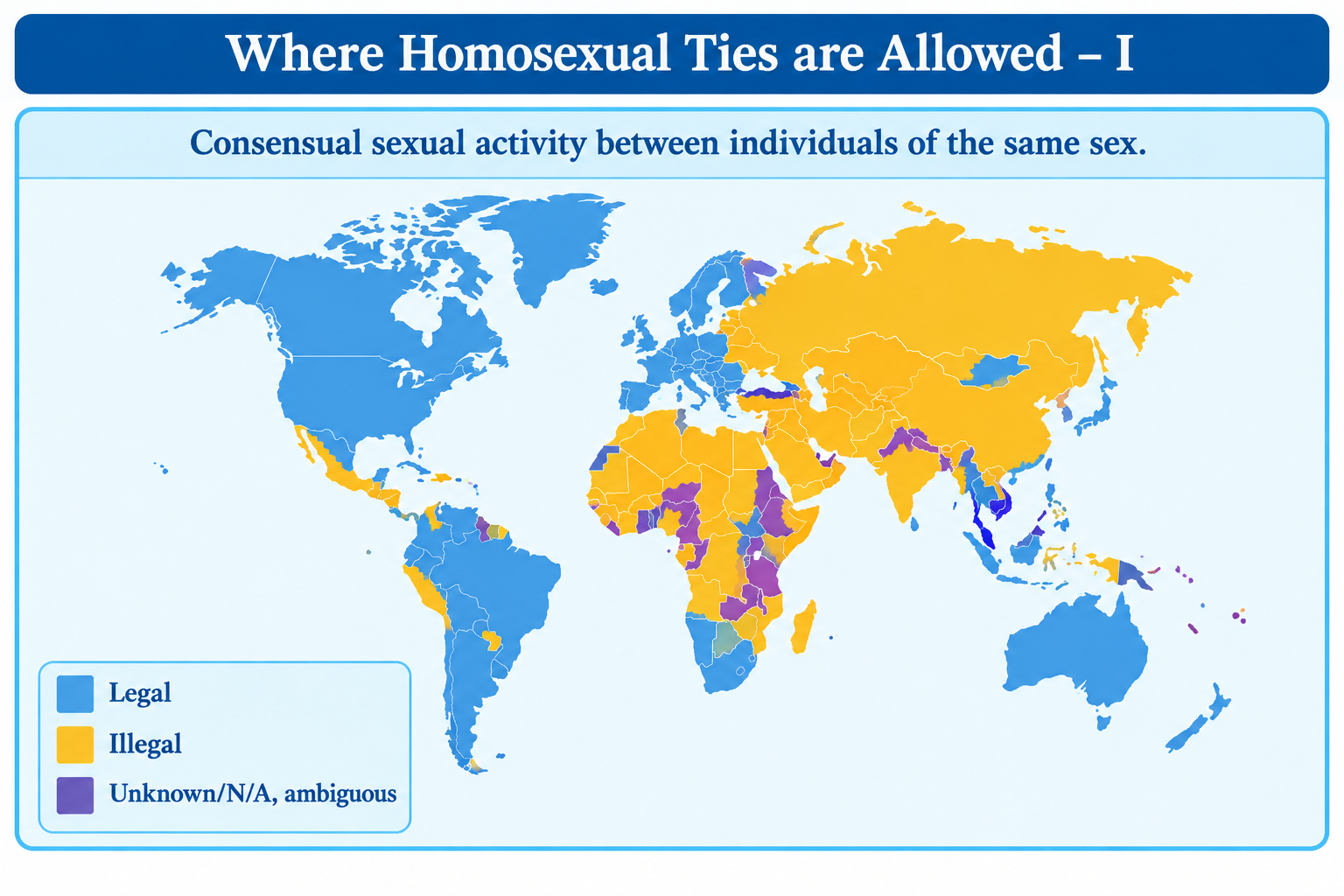
In Lawrence v Texas, the United States Supreme Court delivered a monumental constitutional ruling establishing that government laws penalizing consensual same-sex intimate conduct in the privacy of a home violate the Due Process Clause of the Fourteenth Amendment.
Explicitly overruling the 1986 Bowers v Hardwick precedent, a 5–4 majority led by Justice Kennedy affirmed that moral disapproval alone does not constitute a legitimate state interest justifying government intrusion into the personal liberty and decisional autonomy of consenting adults.
This decision mirrors a broader global trend in human rights jurisprudence—exemplified by ECHR rulings (Dudgeon, Norris), South African constitutional precedent (National Coalition), and progressive enactments in Canada, Ireland, and New Zealand—which treat sodomy bans as unconstitutional invasions of dignity, privacy, and equality.
Furthermore, in United States v Windsor, the US Supreme Court expanded these protections by striking down Section 3 of the Defense of Marriage Act (DOMA) under the Fifth Amendment, holding that denying federal spousal benefits to same-sex couples is unconstitutionally discriminatory.
In simple terms, Lawrence v Texas and its global counterparts established that private, consensual adult sexual intimacy is a protected constitutional right that cannot be criminalized based on public moral disapproval, laying the foundation for full legal equality and spousal recognition.
United States v Edith Schlain Windsor
In United States v Edith Schlain Windsor, the United States Supreme Court evaluated the constitutional validity of Section 3 of the Defense of Marriage Act (DOMA), which restricted federal definitions of “marriage” and “spouse” exclusively to heterosexual unions.
After surviving spouse Edith Windsor was assessed $\$363,053$ in federal estate taxes following the death of her lawful same-sex spouse—a tax burden exempted for opposite-sex surviving spouses under 26 U.S.C. Section 2056(a)—she challenged DOMA under the Fifth Amendment.
A 5–4 majority led by Justice Kennedy held that Section 3 of DOMA is unconstitutional because its primary purpose and practical effect are to disparage, demean, and impose a legal stigma upon same-sex couples whose marriages are recognized as valid under state law.
By deviating from the federal government’s historic deference to state marital definitions, DOMA impermissibly deprived same-sex spouses of equal protection and liberty guaranteed by the Due Process Clause of the Fifth Amendment.
In simple terms, the US Supreme Court struck down DOMA’s federal ban on same-sex marriage recognition, ruling that the federal government cannot strip legally married same-sex couples of federal spousal rights and tax exemptions.
Dennis Hollingsworth v Kristin M. Perry
In Dennis Hollingsworth v Kristin M. Perry, the United States Supreme Court resolved a critical procedural and constitutional challenge to California’s Proposition 8—a voter-enacted state constitutional amendment limiting marriage exclusively to opposite-sex couples.
After same-sex couples successfully challenged Proposition 8 in the US District Court under the Equal Protection and Due Process Clauses of the Fourteenth Amendment, California state officials declined to defend the ban on appeal, leading the private proponents of the initiative to intervene.
While the Ninth Circuit Court of Appeals affirmed the unconstitutionality of Proposition 8 under Romer v Evans on the grounds that withdrawing the official designation of marriage served no legitimate state purpose beyond codifying private moral disapproval, a 5–4 majority of the US Supreme Court speaking through Chief Justice Roberts disposed of the case strictly on jurisdictional grounds.
The Supreme Court held that private initiative sponsors lack constitutional standing under Article III, Section 2 to defend a state law when state government officials refuse to do so, as they suffer no direct, personal injury.
In simple terms, because the private sponsors had no legal standing to appeal, the Supreme Court dismissed the case, thereby leaving the federal trial court’s ruling in place and permanently legalizing same-sex marriage in California.
8.20.4: Homosexuality in the Islamic World
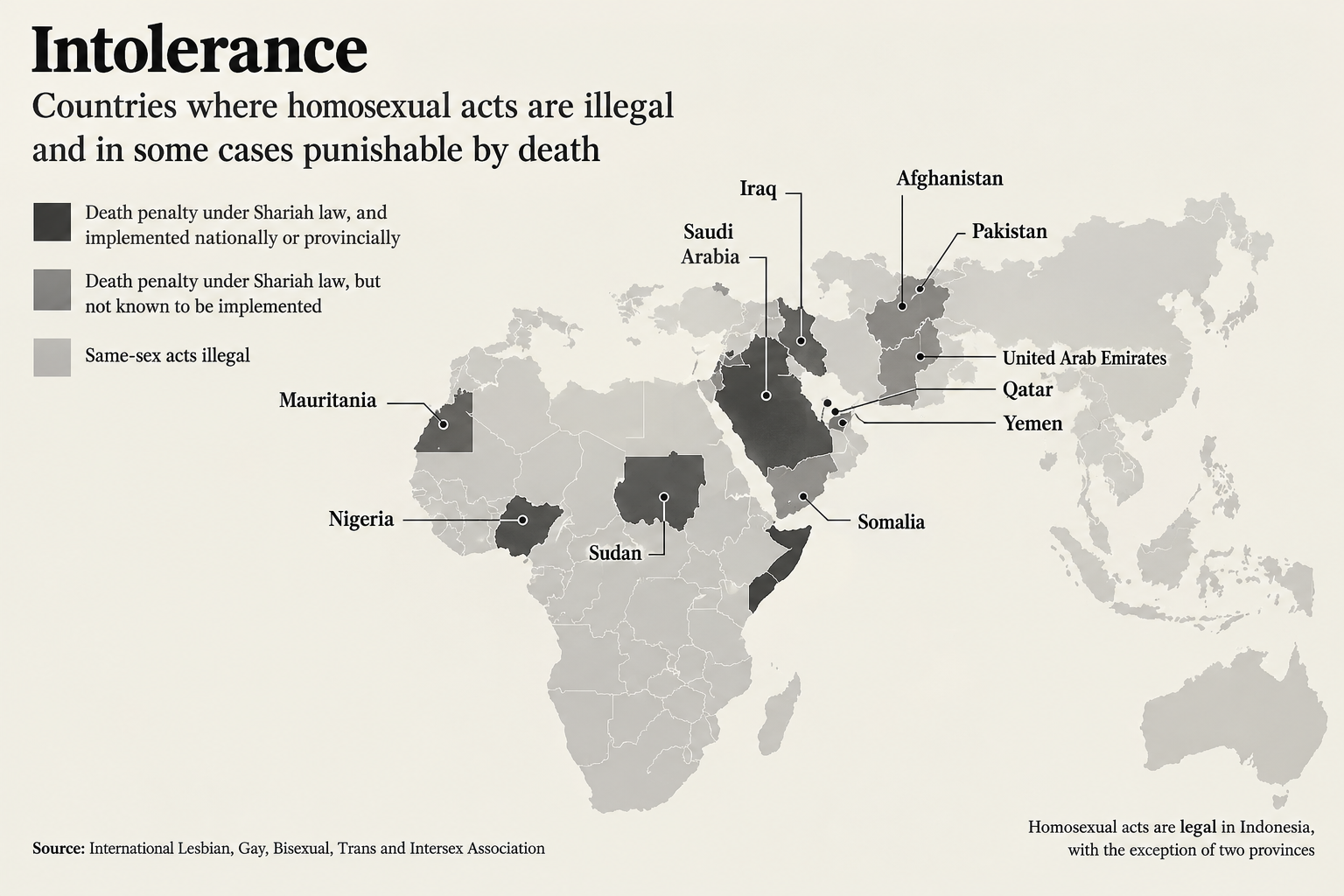
The statutory penal structures, jurisprudential doctrines, and social attitudes surrounding homosexuality across the Islamic world, where over 40 out of 57 Muslim-majority states criminalize same-sex intimacy under penalties ranging from fines and imprisonment to corporal and capital punishment.
Under classical Sharia jurisprudence—as outlined by legal scholars and historical school traditions including Malikite, Shafi’ite, Hanbalite, and Shi’ite—homosexual acts are proscribed as capital offenses, with prescribed executions ranging from stoning and beheading to immolation or throwing from heights.
While statutory enforcement varies—ranging from rarely invoked life sentences in Pakistan to active executions in Iran and corporal penalties in Saudi Arabia—nearly a dozen nations and terrorist entities (such as ISIS) maintain or carry out death sentences for same-sex conduct.
Coupled with widespread moral disapproval reflected in demographic surveys and extremist attacks like the 2016 Orlando shooting, the legal framework demonstrates how traditional religious prohibitions continue to shape formal state laws, informal societal sanctions, and extrajudicial violence targeting sexual minorities across much of the region.