
OFFENCES AGAINST THE STATE
Chapter VI of the Indian Penal Code, 1860 (Sections 121–130), which provides the legal framework for punishing crimes directed against the existence and legal authority of the State.
The statutory centerpiece, Section 121 IPC, penalizes waging war, attempting to wage war, or abetting the waging of war against the Government of India, placing all three stages of complicity on equal legal footing and attaching the capital punishments of death or life imprisonment alongside fine.
Derived from the inherent right of State self-preservation and the doctrine of de jure gentium, the term “whoever” subjects both citizens and foreign nationals to prosecution upon entering Indian territory.
As affirmed by the Supreme Court in the 2012 landmark judgment on the 26 November 2008 Mumbai Terrorist Attack, large-scale armed terrorist strikes aimed at devastating public infrastructure, human life, and national stability constitute the offense of waging war against the Government of India under Section 121 IPC, warranting the highest statutory penalty.
Mohd Ajmal Amir Kasab v. State of Maharashtra
In Mohd Ajmal Amir Kasab v. State of Maharashtra, the Supreme Court, per Aftab Alam and Chandramauli Prasad, JJ., affirmed the conviction and death sentence of the sole surviving operative of the 26/11 Mumbai terrorist attacks under Section 121 IPC for waging war against the Government of India, alongside offenses under Section 302 IPC, Section 120B IPC, and Section 16 of the UAPA, 1967.
The Court held that the cross-border conspiracy—meticulously planned in Pakistan to launch an armed assault on India’s financial capital, execute civilians and foreign nationals, murder high-ranking police personnel, and provoke internal instability—constituted a direct challenge to the nation’s legal authority and territorial integrity, fully satisfying the statutory ingredients of waging war under Section 121 IPC.
Applying the Machhi Singh benchmark for the “rarest of rare” doctrine, the Court determined that the sheer scale of destruction, loss of 166 lives, and total absence of remorse or reformative potential completely overwhelmed the mitigating factor of the appellant’s youth, justifying the capital sentence.
Regina v. Gul
In Regina v. Gul (Mohammed), the appellate court affirmed the conviction of a British national under Section 2 of the Terrorism Act 2006 for disseminating terrorist publications after he uploaded videos online that glorified insurgent attacks against British and coalition military forces in Iraq and Afghanistan.
In rejecting the defense contention that insurgent attacks targeting armed forces during an armed conflict are exempt from the classification of terrorism under international law standards, the court held that Section 1 of the Terrorism Act 2000 unambiguously encompasses acts of violent insurgency directed against state military forces anywhere in the world when executed for political, religious, or ideological purposes to influence a government.
The ruling firmly establishes that domestic anti-terrorism statutory frameworks create no legal exception or immunity for individuals engaged in an armed struggle against a sovereign government, thereby treating the glorification and promotion of such attacks as criminal terrorist encouragement.
SEDITION
The legal frameworks for Sedition under Section 124A IPC and Statements Conducive to Public Mischief under Section 505 IPC.
Section 124A IPC criminalizes bringing or attempting to bring hatred, contempt, or disaffection towards the government through words, signs, or visible representations, prescribing penalties ranging from fine or three years’ imprisonment to life imprisonment.
Explanations 2 and 3 explicitly protect lawful disapproval of government policies or administrative actions.
Section 505 IPC penalizes publishing or circulating statements or rumors intended to cause military mutiny, public panic, or inter-community disharmony, while providing an exception for true statements published in good faith.
As established in landmark 1962 Supreme Court jurisprudence (Kedarnath Singh), Sections 124A and 505 IPC remain constitutionally valid under Article 19(2) of the Constitution because their applicability is strictly restricted to acts containing an intent or tendency to incite public disorder or violence, leaving strongly worded criticism of the government protected under free speech guarantees.
Kedar Nath Singh v. State of Bihar & State of UP v. Ishaq Ilimi
In the landmark decision of Kedar Nath Singh v. State of Bihar (alongside State of UP v. Ishaq Ilimi), a Constitution Bench led by Sinha, C.J., upheld the constitutional validity of Sections 124A and 505 of the Indian Penal Code, 1860, against challenges claiming they violated freedom of speech under Article 19(1)(a).
Reconciling colonial case law with constitutional guarantees, the Supreme Court established that the statutory expression “in the interest of public order” under Article 19(2) saves these penal provisions, provided their application is strictly confined to speech or writings that contain an intention or pernicious tendency to incite violence or create public disorder.
The Court emphasized that “disaffection” and disloyalty are not equivalent to severe disapproval of government actions or administrative policies.
Strongly worded criticism aimed at altering government policies through lawful means remains fully protected under Article 19(1)(a), whereas speech encouraging violent subversion or inter-group violence falls squarely within reasonable restrictions under Article 19(2).
Emperor v. Mohandas Karamchand Gandhi
In the historic 1922 trial of Emperor v. Mohandas Karamchand Gandhi, the colonial state prosecuted Gandhiji under Section 124A of the Indian Penal Code, 1860, for publishing three articles in Young India alleged to excite hatred, contempt, and disaffection toward British rule.
Pleading guilty to the charges, Gandhiji delivered a statement tracing his transformation from a decorated supporter of the Empire to an active non-cooperator, catalyzed by the Rowlatt Act, the Jallianwala Bagh massacre, and economic exploitation that impoverished the nation.
Critiquing Section 124A IPC as the “prince among the political sections… designed to suppress the liberty of the citizen,” he asserted that affection cannot be manufactured or regulated by statutory law and that non-violent non-cooperation with an oppressive system constitutes a moral obligation.
By inviting the court to impose the highest penalty for what was legally a deliberate crime but morally a citizen’s duty, the trial highlighted the tension between colonial statutory suppression of “disaffection” under Section 124A IPC and fundamental principles of freedom of expression and non-violent political dissent.
SESSION COURT AHEMDABAD- 1922
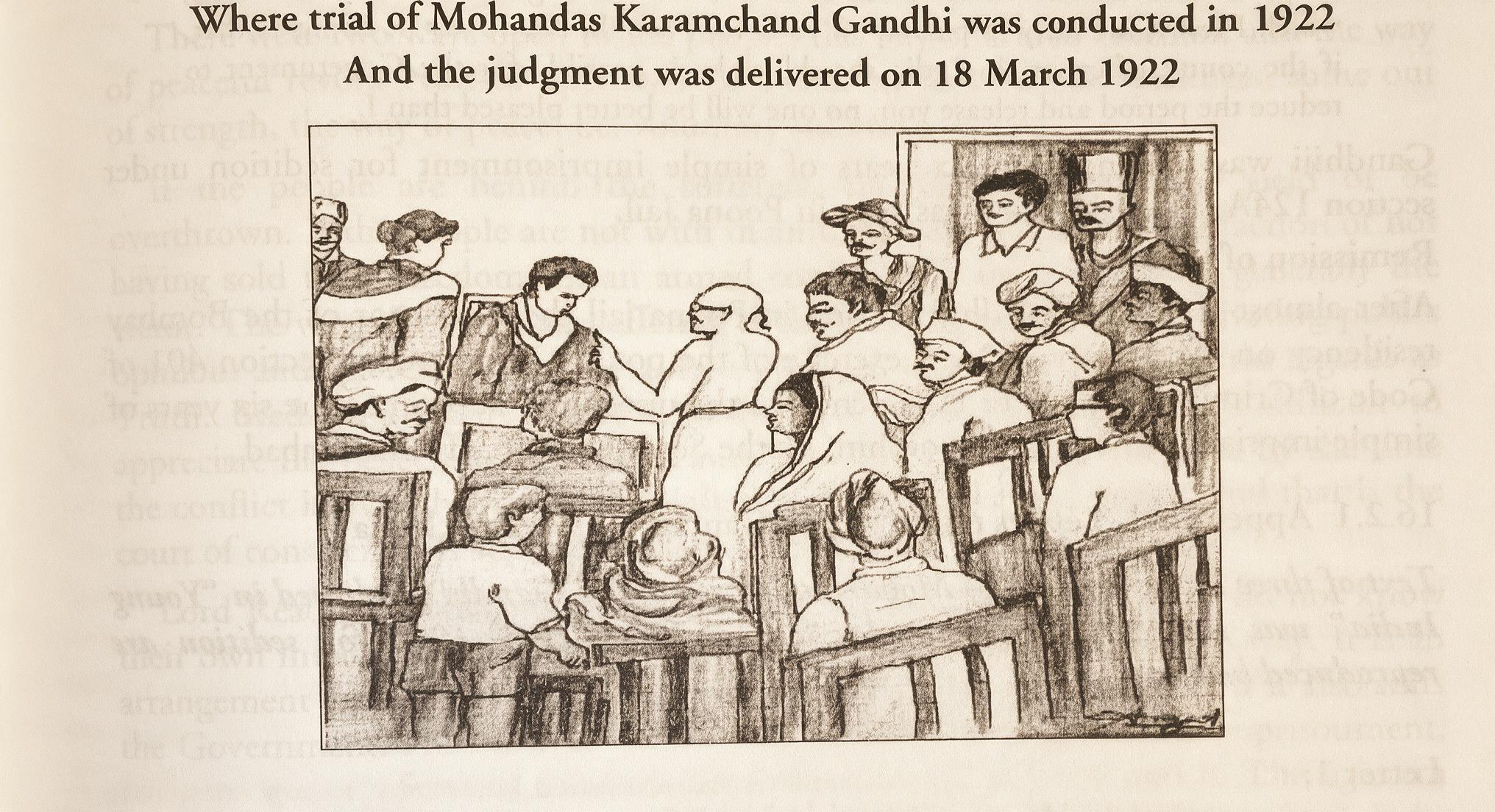
On 18 March 1922, the Sessions Court at Ahmedabad delivered its historical judgment in Emperor v. Mohandas Karamchand Gandhi, convicting Gandhiji on his plea of guilty for sedition under Section 124A of the Indian Penal Code, 1860.
While acknowledging Gandhiji’s stature as a patriot and his commitment to non-violence, the judge observed that the law must treat all citizens equally and passed a total sentence of six years’ simple imprisonment (two years for each of the three articles in Young India), drawing a direct procedural precedent from Bal Gangadhar Tilak’s earlier sedition sentence.
Imprisoned in Poona Jail, Gandhiji served a portion of his term until 4 February 1924, when the Governor of Bombay exercised executive power under Section 401 of the Code of Criminal Procedure, 1898, to remit the remaining unexpired sentence and grant his release.
Appendix-I
In the first article titled “The Puzzle and Its Solution”, published in Young India and forming part of the evidence under Section 124A IPC, Mohandas Karamchand Gandhi responded directly to Viceroy Lord Reading’s statements regarding non-co-operators inviting arrest.
Declaring that the non-co-operation movement was actively “at war” and engaged in a “peaceful revolt” against the colonial government, Gandhiji articulated an explicit intent to challenge, resist, and compel the submission of a regime whose actions he characterized as “wholly evil“.
Rejecting armed rebellion in favor of voluntary suffering, mass courtment of arrest, and uncomplaining submission to imprisonment, the writing asserted that the moral authority of the “court of conscience” supersedes established judicial courts.
By openly advocating for the overthrow of government authority through non-violent non-cooperation and peaceful resistance, this publication provided the colonial state with direct statutory grounds to allege that the text excited disaffection, hatred, and political discontent under Section 124A of the Indian Penal Code, 1860.
Letter 2 : Tampering with Loyalty
In the second article, “Tampering with Loyalty”, published in Young India, Mohandas Karamchand Gandhi directly addressed the Governor of Bombay’s prosecution of the Ali Brothers for enticing army sepoys to breach their allegiance.
Openly claiming responsibility for advocating that Indian soldiers and civilians refrain from serving an oppressive administration, Gandhiji characterized serving a government guilty of the Punjab atrocities and Khilafat breaches as morally indefensible.
He explicitly conceded that preaching disaffection and seeking the ultimate overthrow of the regime fell squarely within the statutory definition of sedition under Section 124A of the Indian Penal Code, 1860.
Framing non-violent sedition not as a conventional crime but as a moral imperative (dharma), the article called upon movement workers to systematically spread disaffection from public platforms and willingly accept statutory penalties without seeking legal immunity or quarter.
Letter 3 : Shaking the Manes
In the third and final article, “Shaking the Manes”, published in Young India and utilized by the prosecution under Section 124A IPC, Mohandas Karamchand Gandhi responded to British threats of military force and uncompromising imperial authority voiced by officials like Lord Birkenhead and Mr. Montagu.
Reasserting India’s 1920 Calcutta pledge demanding complete swaraj and redress for the Punjab and Khilafat wrongs, Gandhiji contrasted the brute force and organized exploitation of the British Empire with the moral resolve of India’s unarmed millions.
He declared that submission to colonial insolence had become an absolute impossibility and framed the ongoing campaign as a permanent “fight to the finish“.
By publicly urging the nation to reject imperial tutelage, sustain an unyielding struggle, and maintain strict non-violence against potential state oppression, the publication provided clear evidence of exciting political disaffection and defiance under Section 124A of the Indian Penal Code, 1860.
R v. Rowe
In R v. Rowe, the appellate court dismissed an appeal against a conviction on two counts under Section 57 of the Terrorism Act 2000, which penalizes the possession of articles giving rise to a reasonable suspicion of being connected with the commission, preparation, or instigation of terrorism.
The evidence established that the appellant possessed handwritten notes containing instructions for operating a gun and a coded system detailing explosive components, susceptible bombing targets, and foreign countries.
Analyzing the statutory framework, the court contrasted Section 57, which requires a specific purpose connected to terrorism, with Section 58, which prohibits collecting or holding information likely to be useful to a terrorist without requiring proof of a specific intent.
Together, these provisions support the broad definition of terrorism under Section 1 of the 2000 Act—encompassing actions involving serious violence, property damage, or public endangerment designed to influence governments or advance political, religious, or ideological causes.
Offences Relating to the Army, Navy and Air Force
Chapter VII of the Indian Penal Code, 1860 (Sections 131–140), which governs offences relating to the Army, Navy, and Air Force.
By virtue of Section 139 IPC, active-duty personnel subject to specialized military legislation such as the Army Act, Naval Discipline Act, or Air Force Act are excluded from the scope of these Penal Code provisions, ensuring they remain under dedicated military jurisdiction.
Consequently, Chapter VII primarily targets civilians or individuals not bound by military law who incite, exhort, or assist members of the armed forces to commit mutiny, desertion, or gross breaches of military discipline.