
Amnesty International 31 December 2020
According to data cited from Amnesty International as of December 31, 2020, the Russian Federation officially established a moratorium on executions in August 1996.
However, this national policy was not uniformly enforced across all regions, as executions continued to take place in the Chechen Republic between 1996 and 1999.
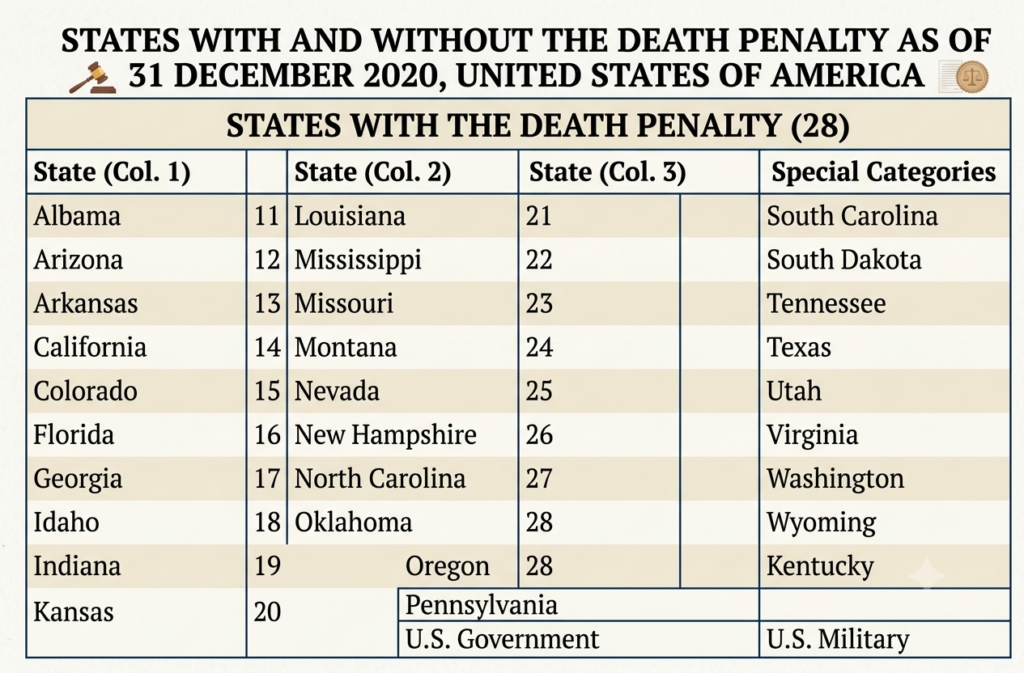
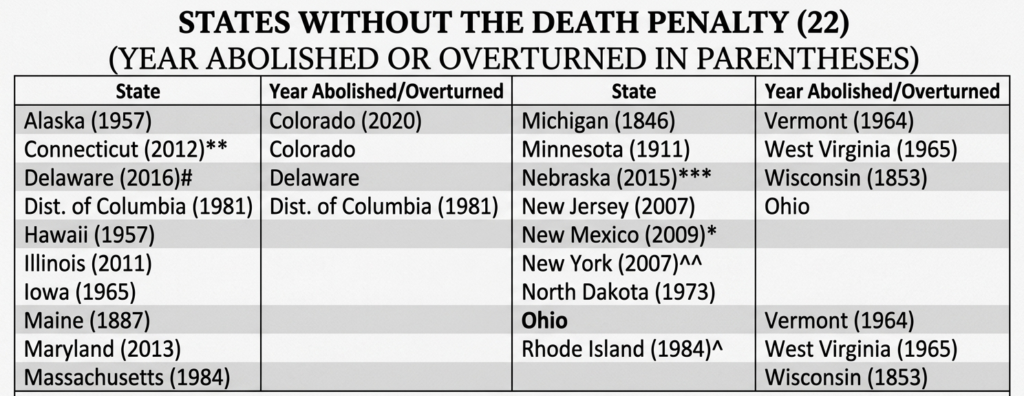
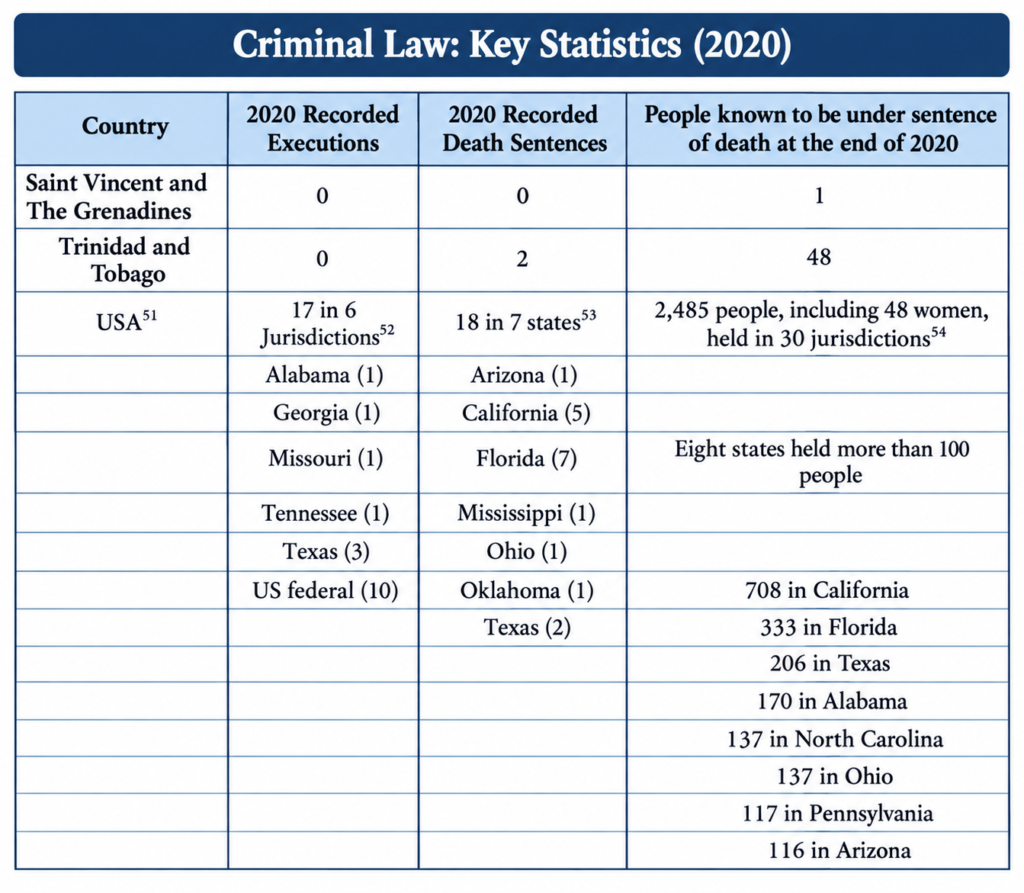
According to the Amnesty International report dated December 31, 2020, the United States recorded its lowest execution count in nearly three decades with 17 executions, driven by two opposing developments.
On one hand, the Trump administration ended a 17-year federal hiatus by carrying out 10 federal executions in less than six months, accounting for more than half of the nation’s total.
On the other hand, state-level executions and new death sentences dropped significantly due to COVID-19 court disruptions, lethal injection supply shortages, and state-level moratoriums, though Texas still accounted for nearly half of all non-federal executions.
By the end of 2020, 22 US states had abolished capital punishment, and 12 retaining states had gone over a decade without an execution.
Globally, in the Caribbean region, COVID-19 similarly halted judicial proceedings and visitation rights across multiple island nations, leaving Trinidad and Tobago as the only country in the region to hand down new mandatory death sentences.
Notable Country Developments
In 2020, capital punishment practices across the Americas were defined by major legislative reforms in the Caribbean alongside severe health and procedural disruptions caused by the COVID-19 pandemic.
Countries like Barbados formally repealed the mandatory death penalty, and appellate courts in Guyana and Trinidad and Tobago commuted long-standing sentences on constitutional grounds.
Concurrently, the global pandemic severely compromised capital defense rights in the United States, as visit suspensions, disrupted trials, and virus outbreaks hampered mental health evaluations and legal representation—causing nearly half of all death row deaths in detention to result from COVID-19.
Despite these extraordinary conditions, the US federal government ended a 17-year hiatus by executing 10 individuals in rapid succession.
These federal executions repeatedly drew criticism for violating international human rights standards by expediting warrants past court motion deadlines, executing individuals with severe mental and intellectual conditions like Alzheimer’s and schizophrenia (e.g., Wesley Ira Purkey), overriding Native American tribal sovereignty (e.g., Lezmond Mitchell), and proceeding despite documented trial flaws involving racial discrimination and all-white juries (e.g., Orlando Hall).
7.6.2 Death Sentences and Executions 2020 Global Trends
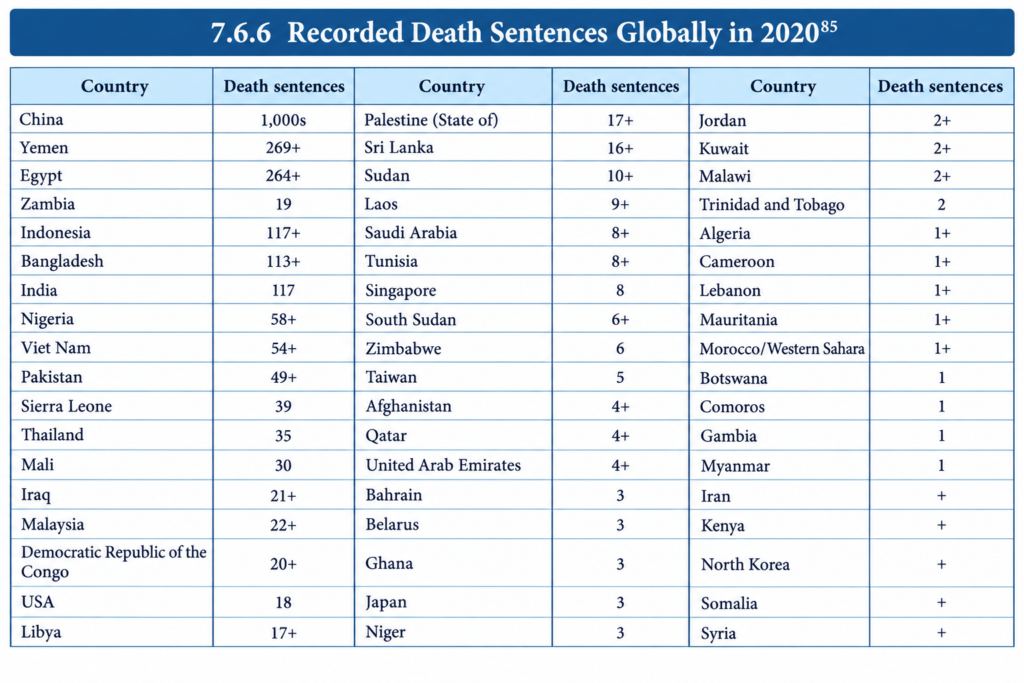
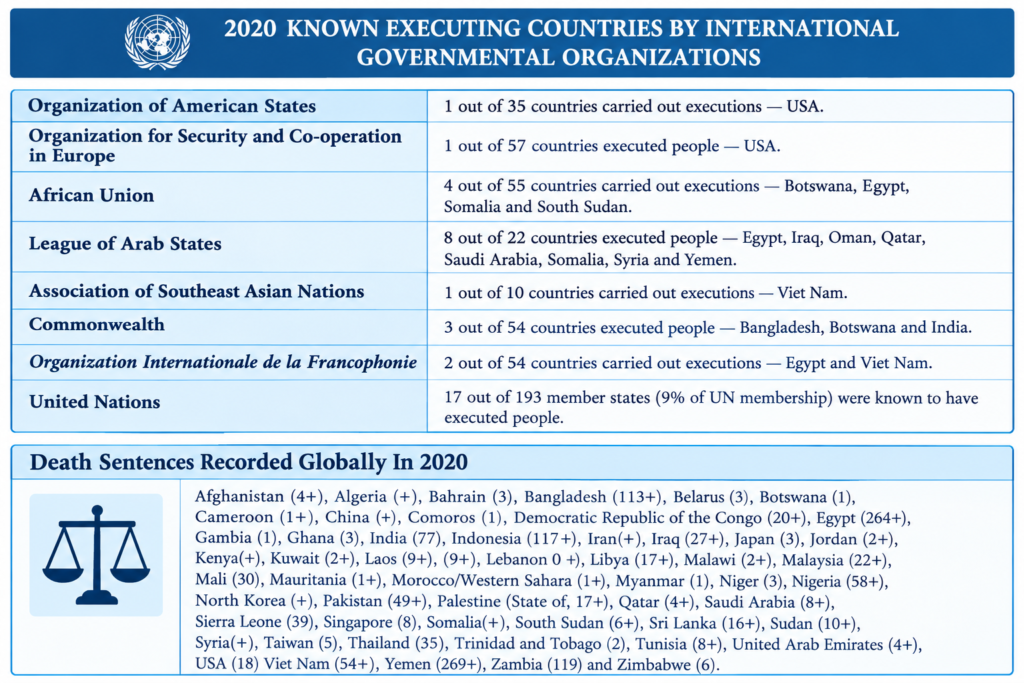
Under Section 7.6.2, titled Death Sentences and Executions 2020 Global Trends, the text outlines how capital punishment declined worldwide in 2020, reaching its lowest execution total in more than ten years as known executions fell by 26% and the number of executing states shrank to 18.
While the COVID-19 pandemic caused widespread judicial delays that reduced newly imposed death sentences by 36% (down to 1,477), it also worsened conditions for prisoners.
Major drops in execution figures in Iraq and Saudi Arabia contributed to the global decline, yet countries like Egypt sharply increased executions, and nations including India, Oman, Qatar, Taiwan, and the US federal government actively resumed state killings.
Nevertheless, structural momentum toward global abolition remained strong: Chad fully abolished capital punishment, Colorado became the 22nd US abolitionist state, Barbados ended mandatory death sentencing, Sudan abolished the death penalty for apostasy, and Saudi Arabia ended capital punishment for juvenile offenders in non-terrorism cases.
This shifting international stance was further underlined in December 2020 when a record 123 countries voted in favor of the UN General Assembly’s resolution calling for a global moratorium on executions.
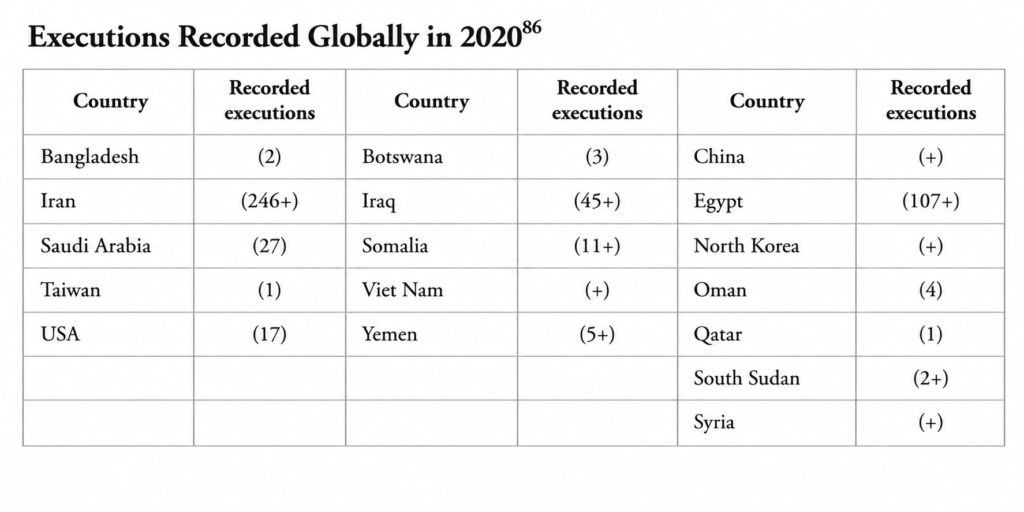
7.6.4 Executions Recorded Globally in 2020
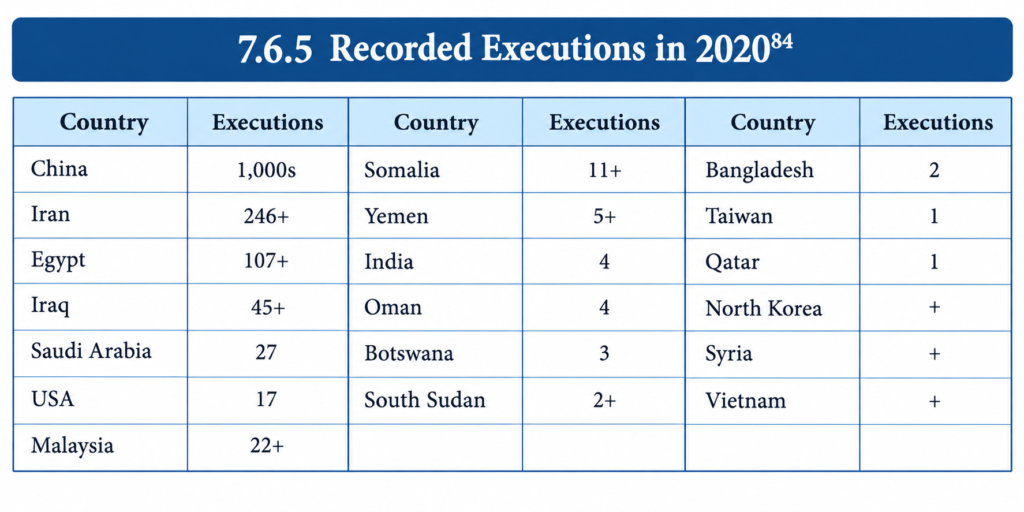
Under Section 7.6.4, titled Executions Recorded Globally in 2020, the provided text presents country-specific judicial execution figures, ranging from isolated instances in countries like Qatar (1), Taiwan (1), and Bangladesh (2) to larger minimum counts in Egypt (107+), Iran (246+), and China (thousands).
Amnesty International notes that these statistics reflect strictly official judicial executions based on confirmed evidence, excluding extrajudicial actions.
Because several states actively conceal capital proceedings or do not make public records available, the true totals are often higher.
To account for these reporting limitations, a “$+$” following a number indicates confirmed cases exceeding the stated figure, while a standalone “$+$” denotes confirmed executions where exact counts remain unknown—treated as a baseline value of two for regional and global aggregate calculations.
Recorded Executions in 2020
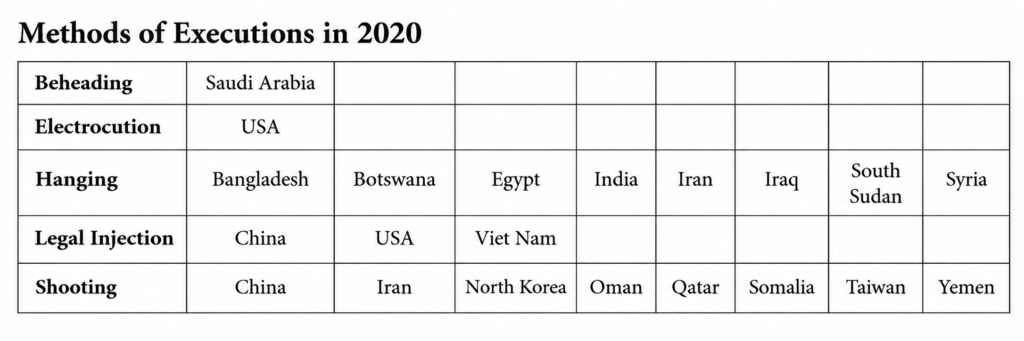
Under the section titled Recorded Executions in 2020, the text outlines how global executions reached a decade-low minimum of 483 cases across 18 countries—a 26% decline from 2019 and a 70% drop from the 2015 peak of 1,634.
Despite this broader decline, 88% of all recorded executions were concentrated in four countries: Iran (246+), Egypt (107+), Iraq (45+), and Saudi Arabia (27).
These figures represent a strict minimum baseline, as data from China remains hidden under state secrecy laws, and access to records in North Korea and Vietnam remains severely constrained.
Women accounted for 3% (16 cases) of the global total, with executions taking place in Egypt, Iran, Oman, and Saudi Arabia.
While significant reductions in Saudi Arabia (down 85%) and Iraq (down over 50%) drove down the overall global sum, Egypt tripled its execution count, and countries such as India, Oman, Qatar, Taiwan, and the US federal government resumed executions after various hiatuses.
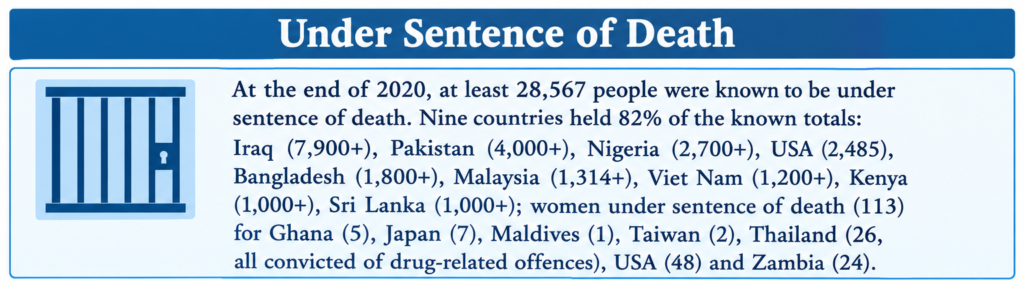
7.6.8 Commutation of Death Sentence
Commutation of Death Sentence, the legal framework of India grants the appropriate executive authority—the Central Government for Union Territories and State Governments for States—the statutory power under Sections 54 and 55 of the Indian Penal Code, 1860, and Sections 432–434 of the Criminal Procedure Code, 1973, to commute or substitute a death sentence into another form of punishment.
The government retains the discretion to exercise this authority on its own initiative without a direct petition from the convict.
As expressed by the framers of the IPC, this executive prerogative exists because governments are uniquely equipped to weigh broader circumstances and practical considerations that may not be available to or suitable for judicial evaluation.
Consequently, post-conviction commutation generally lies beyond court jurisdiction, though statutory exceptions permit High Courts to postpone or commute death sentences for pregnant women and allow Sessions Courts to tender pardons to accomplices whose testimony is essential to secure a conviction in multi-defendant cases.
7.6.9 Power of Pardon: Constitutional Provisions
Power of Pardon: Constitutional Provisions, the text details how Articles 72 and 161 of the Constitution of India invest the President and State Governors with purely executive pardoning powers.
These provisions empower executive authorities to grant pardons (absolute or conditional), reprieves (temporary suspensions), respites (postponements of execution dates), remissions (reducing punishment duration without altering its type), or commutations (substituting a sentence) to any convicted person.
While both the President and State Governors possess concurrent constitutional jurisdiction regarding the suspension, remission, and commutation of death sentences, the President holds exclusive authority when granting full pardons, reprieves, and respites in capital punishment cases.
7.6.9.1 Pardon: Extent and Scope
Pardon: Extent and Scope, a pardon is defined as an executive act of grace that excuses an accused individual from punishment, wiping away the guilt entirely to restore their original legal state of innocence.
As a purely discretionary power that cannot be claimed as a matter of right, clemency allows the head of State to evaluate humanitarian and extrajudicial factors without any legal obligation to conduct oral hearings for the parties involved.
Although this discretionary nature has historically led to political abuse—such as the executions of Zulfikar Ali Bhutto in Pakistan and Ken Saro-Wiwa in Nigeria despite widespread international appeals—retaining the power of pardon remains essential to criminal jurisprudence.
It serves as a vital safeguard to prevent wrongful punishment and correct judicial errors, grounded in the principle that freeing a guilty person is preferable to punishing an innocent one.
To mitigate political caprice and relieve the executive branch of complex evaluations, the text suggests adopting independent parole boards or high-powered committees to administer conditional pardons, mirroring successful models in several US states.
7.6.10 Imprisonment for Life
Imprisonment for Life, the text clarifies that a life sentence legally extends throughout the entire remaining natural life of a convict.
In the landmark KM Nanavati case, the Supreme Court of India established that for murder convictions, life imprisonment must be rigorous in nature rather than simple imprisonment.
While inmates can earn remissions for good behavior, Section 57 of the IPC, 1860, specifies that a life sentence is treated as 20 years solely for mathematical calculations regarding remission.
Furthermore, Section 55 of the IPC supplements Section 54 by granting executive authorities the power to commute a life sentence to a term not exceeding 14 years, an executive discretion that can be exercised independently without the consent of the accused.
7.6.10.1 Commutation and Remission Distinguished
commutation alters the nature of the punishment to a different, less severe category, whereas remission reduces the duration of the punishment without altering its underlying character.
For instance, if a life sentence is commuted under Section 55 of the IPC to a 14-year term, the individual is no longer under a life sentence upon release; conversely, if a life sentence is remitted under Section 432 of the CrPC, the inmate legally remains under a sentence of life imprisonment.
In addition to statutory provisions under Sections 73 and 74 of the IPC governing the court’s authority and explicit limitations regarding solitary confinement in cases of extreme atrocity, the text highlights global data from Amnesty International’s 2020 report.
This data documents that 33 nations—including India, the USA, Japan, and Pakistan—granted commutations or pardons for capital sentences, while at least 18 death row prisoners were fully exonerated across six countries, including the USA (6), Zambia (6), Cameroon (3), China (1), Singapore (1), and Taiwan (1).
7.6.11 Ex-post facto laws:
Ex-post facto laws, the text addresses the prohibition against applying retroactive penal legislation.
An ex-post facto law that imposes or calls for a greater penalty than the punishment that was legally in effect when the crime was committed violates the constitutional guarantees of the US Constitution, as reaffirmed by the US Supreme Court in a 2013 ruling.
This fundamental principle ensures that individuals cannot be subjected to harsher criminal sanctions retroactively, protecting accused individuals from retroactive increases in punishment.
Peugh v. United States
In the Supreme Court case Peugh v. United States, petitioner Peugh was convicted of five counts of bank fraud committed in 1999 and 2000.
During sentencing, Peugh argued that applying the 2009 Federal Sentencing Guidelines—which carried an increased range of 70 to 87 months—violated the Ex Post Facto Clause, as the 1998 Guidelines in effect at the time of his offenses set a lower range of 30 to 37 months.
Although lower courts rejected his argument and sentenced him to 70 months, the US Supreme Court reversed the decision in a 5–4 ruling, establishing that applying updated guidelines retroactively creates a significant risk of a harsher sentence.
The Court held that altering the substantive calculation formula after an offense has been committed offends fundamental justice, affirming that judicial discretion to deviate from guidelines does not strip defendants of their constitutional protection against retroactive punishment increases.
7.6.11.1 Limit to Punishment
Under Section 7.6.11.1, Limit to Punishment, Sections 71 and 72 of the Indian Penal Code (IPC), 1860, establish guidelines for sentencing in complex scenarios involving multiple constituent minor offenses or uncertainty regarding the precise crime committed.
Section 75 of the IPC addresses recidivism by empowering courts to impose enhanced punishments on repeat offenders, reasoning that prior penalties proved ineffective in deterring criminal behavior.
Furthermore, the text highlights a 1983 Supreme Court ruling regarding Section 54 of the IPC, which established that a delay in executing a death sentence does not automatically entitle a convict to a commutation to life imprisonment.
Sher Singh v. State of Punjab
In Sher Singh v. State of Punjab, the Supreme Court of India departed from the precedent set in TV Vatheeswaran v. State of TN, which had ruled that any execution delay exceeding two years entitled a convict to invoke Article 21 and have their death sentence commuted to life imprisonment.
The Court clarified that while prolonged delay remains a vital factor in judicial evaluation, a rigid two-year rule fails to account for the practical realities of court procedures and executive decision-making.
Statistical evidence shows that appeals through the judicial hierarchy routinely span four to five years, even before considering mercy petitions submitted under Articles 72 or 161 of the Constitution or statutory applications under Sections 432 and 433 of the CrPC.
Consequently, the Court held that substituting a death sentence with life imprisonment cannot occur automatically through a strict mathematical formula, ultimately refusing to vacate the death sentence in this matter and affirming in a 1989 decision that execution delays do not inherently render a death sentence inoperative.
Triveniben v State of Gujarat
In Triveniben v. State of Gujarat, a unanimous five-judge Constitution Bench of the Supreme Court resolved earlier judicial conflicts by ruling that prolonged delays in executing a death sentence do not automatically entitle a convict to a reduced sentence of life imprisonment.
Delivering the judgment, Justice G.L. Oza clarified that while an inmate may approach the apex court under Article 32 regarding inordinate execution delays post-final judicial confirmation, the court will evaluate the circumstances on a case-by-case basis rather than enforcing a rigid time limit, without reopening the original conviction.
Furthermore, regarding Section 57 of the Indian Penal Code, 1860, the text emphasizes that life imprisonment is not limited to a fixed 20-year term; although Section 57 equates life imprisonment to 20 years for calculation purposes, a life sentence does not automatically expire after 20 years, as the authority to commute, remit, or suspend such sentences rests exclusively with the appropriate government under Section 432 of the CrPC rather than the judiciary.
State of MP v Ratan Singh
In State of MP v Ratan Singh, the Supreme Court of India set aside a High Court order that had granted automatic release to a life convict who had completed 20 years of imprisonment under local jail manual provisions.
Authoring the judgment, Justice Fazalali reaffirmed established precedents from Gopal Vinayak Godse and Pandit Kishori Lal, holding that life imprisonment inherently means imprisonment for the full duration of a convict’s natural life unless formally remitted by the appropriate government.
The Court established four core principles: administrative jail manuals cannot override statutory provisions of the Indian Penal Code; executive governments maintain sole discretion under Section 432 of the CrPC to grant or deny remission without judicial coercion via writ petitions; the authority to grant remission belongs exclusively to the state where the conviction occurred rather than the receiving state in prisoner transfer cases; and High Courts cannot overturn a convicting state’s refusal to grant remission through writ jurisdiction.
7.6.12 Proportionality of Sentence
Under Section 7.6.12, titled Proportionality of Sentence, the text explores how courts balance penalties to reflect the degree of harm and specific case circumstances.
The principle of proportionality requires maintaining a logical relationship between the time served for attempted murder and the minimum sentence that would have been required had the attempt succeeded in causing death.
Consequently, in instances where an attack inflicts severe harm but presents valid mitigating factors, reducing a sentence from 18 years to 15 years serves as an example of adjusting punishment to align with proportional justice.
R v Sandhu
In R v Sandhu (Manjit), the appellant ($S$) sought leave to appeal an 18-year prison sentence following his conviction for the attempted murder of his estranged wife ($V$), whom he brutally attacked with a knife in the presence of their children, inflicting severe nerve damage, lacerations, and lasting trauma.
The trial judge originally imposed an 18-year sentence after observing that a successful murder would have carried a minimum 15-year term.
On appeal, S argued that the 18-year penalty was manifestly excessive and misapplied the legal comparative standard.
Granting the appeal, the appellate court reaffirmed that sentencing for attempted murder requires a proportionate relationship between the sentence for an attempt and the hypothetical minimum term for a completed crime.
Finding that the attack—though severe and aggravated by its impact on the children—was un-premeditated and subject to mitigating considerations, the court ruled that proportionality was properly preserved by reducing $S$‘s sentence from 18 years to 15 years.
Mahak Singh v State of UP
In Mahak Singh v State of UP, Justice OP Garg clarified that Indian law contains no statutory provision stating that a sentence of life imprisonment automatically expires after a period of 14 or 20 years.
The judgment addressed the common myth that a convict serving more than 14 years of rigorous imprisonment is deemed to have completed their sentence and entitled to immediate release.
Reaffirming the Supreme Court’s ruling in Naib Singh v State of Punjab, the text emphasizes that a prisoner cannot be released purely due to time served unless the State government explicitly issues an order of commutation or remission under Section 55 of the IPC or Section 433(b) of the CrPC.
Additionally, the text notes a 1981 Supreme Court precedent affirming that solitary confinement must be reserved strictly for extreme cases.
Kishore Singh Ravinder Dev v State of Rajasthan
In Kishore Singh Ravinder Dev v State of Rajasthan, Justice V.R. Krishna Iyer reaffirmed that prisoners retain their fundamental constitutional rights under Articles 14, 19, and 21, establishing that incarceration does not place individuals at the unchecked mercy of prison authorities.
The Court ruled that trivial administrative infractions—such as loitering, insolence, or damaging a history ticket—cannot justify harsh punishments like solitary confinement or crossbar fetters.
Holding that prolonged isolation ranging from eight to eleven months is barbarous and violates the legal principles set forth in Sunil Batra’s case, the Supreme Court emphasized that solitary confinement or physical restraints may only be used in the rarest of rare cases for genuine security reasons, strictly adhering to natural justice and providing judicial appeal mechanisms to protect human dignity.
Additionally, the text notes a 1984 Supreme Court decision ruling that gifting land as compensation in lieu of an acquittal on a murder charge is illegal.
Ramesh Kumar v Ram Kumar
In Ramesh Kumar v Ram Kumar, the Supreme Court of India set aside a High Court judgment that had acquitted an accused charged under Section 302 read with Section 34 of the IPC because the accused gifted three acres of land to the murder victim’s widow.
Overturning the High Court’s ruling as illegal, the Supreme Court emphasized that allowing such a precedent would permit wealthy individuals to buy immunity from murder charges by offering land or money to a victim’s heirs.
The Court famously noted that courts are established to “dispense justice, not to dispense with justice,” affirming that criminal liability for heinous offenses cannot be compromised away in India, unlike in jurisdictions like Pakistan where private compromises regarding death sentences are legally recognized.
Mohammad Hanif v State
In Mohammad Hanif v State, two brothers (Muhammad Hanif and Muhammad Shafiq) were convicted and sentenced to death under Section 302 read with Section 34 of the Pakistan Penal Code for murdering their stepmother, Zenab Bibi.
Following the High Court’s decision, the victim’s biological son—who was also the complainant and half-brother of the convicts—filed an affidavit confirming that the family elders had mediated a reconciliation.
To foster peace and amity within the family, the deceased’s children formally forgave their half-brothers and requested their acquittal.
The Supreme Court of Pakistan accepted the compromise as a positive gesture among family members and commuted their death sentences to life imprisonment.
Additionally, the text references a 1978 Supreme Court precedent demonstrating a reformative judicial approach, where an offense of bigamy under Section 494 was compounded by substituting a two-year prison sentence with a ₹40,000 compensation order paid by the husband to his wife.
Narotam Singh v State of Punjab
In Narotam Singh v State of Punjab, Justice V.R. Krishna Iyer examined a matrimonial dispute where a dowry conflict led to marital separation, prompting the husband to form a second union with another woman.
Although the husband was initially convicted and sentenced to two years’ rigorous imprisonment and a fine, the Supreme Court evaluated the practical fallout of punitive incarceration.
Justice Krishna Iyer noted that imprisoning the husband would collapse his business, causing financial hardship to both wives, while doing nothing to repair the broken marriage.
Recognizing that the complainant needed financial resources and security for her future rather than retributive satisfaction, and noting that both parties were willing to settle, the Court adopted a pragmatic approach by compounding the offense and quashing the conviction.
Additionally, the text includes a reference to a 2001 House of Lords ruling affirming a prisoner’s right to confidentiality in legal correspondence.
R v Secretary of State for Home Department, ex parte Daly
In R v Secretary of State for Home Department, ex parte Daly, the House of Lords addressed the legality of a policy introduced on 31 May 1995 across closed prisons in England and Wales, which prohibited prisoners from being present in their cells while staff inspected their privileged legal mail.
Long-term prisoner Daly challenged the measure under Section 47(1) of the Prison Act 1952, common law, and Article 8(1) of the European Convention on Human Rights, arguing that the blanket exclusion unnecessarily infringed upon the fundamental right to legal confidentiality.
Reversing the Court of Appeal’s ruling, Lord Bingham of Cornhill held that the blanket policy was unlawful and void.
The Court determined that while disruptive or intimidating inmates could legitimately be excluded during cell searches, routinely excluding all prisoners without individualized justification impermissibly breached legal confidentiality and human rights safeguards.
Additionally, the text highlights a 1998 Andhra Pradesh High Court ruling affirming that condemned prisoners hold the right to be interviewed.
M Hasan v State of AP
In M Hasan v State of AP, an experienced documentary filmmaker and a freelance journalist challenged the decision of jail authorities denying them permission to interview two condemned prisoners sentenced to death in 1996.
The jail officials justified their refusal on several grounds, arguing that broadcasting such interviews could spark public outcry for sentence commutations, undermine the authority of the judiciary, present prison security hazards, and note that the prisoners had not originally initiated the request.
Allowing the writ petition, the High Court of Andhra Pradesh rejected these administrative objections as improper and held that denying interview access violated fundamental constitutional guarantees.
The Court ruled that both journalists and condemned prisoners retain their rights to freedom of speech and expression under Article 19(1)(a) of the Constitution, affirming that death row inmates possess the right to express and propagate their views through available media without fear or favor, so long as those expressions satisfy the test of reasonable restrictions.